Challenge
Historic Environment Scotland safeguards more than 5,000 years of history, managing extensive archives, collections and heritage data. But before this project, exploring these fully could take specialist research skills.
To find what they needed, users had to jump between four or five separate websites. Each site had its own interface, search logic, and data format. This digital fragmentation created a frustrating barrier for everyone - whether you were an academic digging into Pictish settlements or a tourist planning a road trip.
HES needed more than a cosmetic update; they needed a way to make millions of pieces of history accessible to everyday people.
Solution
We didn't just build a basic search bar. We engineered a highly sophisticated, user-first discovery layer by embedding Manifesto specialists directly within HES teams. By operating as a single, blended Agile team, we broke down institutional silos across key areas:
1. Tech ingenuity & smarter data
Instead of forcing users to understand complex databases, we let technology do the heavy lifting behind the scenes:
The unified index: We brought a broad set of different data sources —including architectural catalogues, archaeological data, and 3D models of historic objects — together into one lightning-fast search index using Azure AI Search.
Advanced discovery: We made it easy for users to find what they need through an intuitive platform featuring advanced keyword and map searches.
Machine learning at scale: We used machine learning algorithms to clean up and normalise metadata across 3 million records. This unlocked smart filtering and "see also" recommendations that were previously impossible.
Modern architecture: We built a fast, dynamic front end using Next.js and integrated Bloomreach as a headless CMS – then replaced it with Umbraco - creating a highly flexible content hub for the HES team.
2. Human-centric design & branding
A powerful technical tool is useless if people find it intimidating. We focused on radical accessibility to make the experience welcoming and inclusive for everyone:
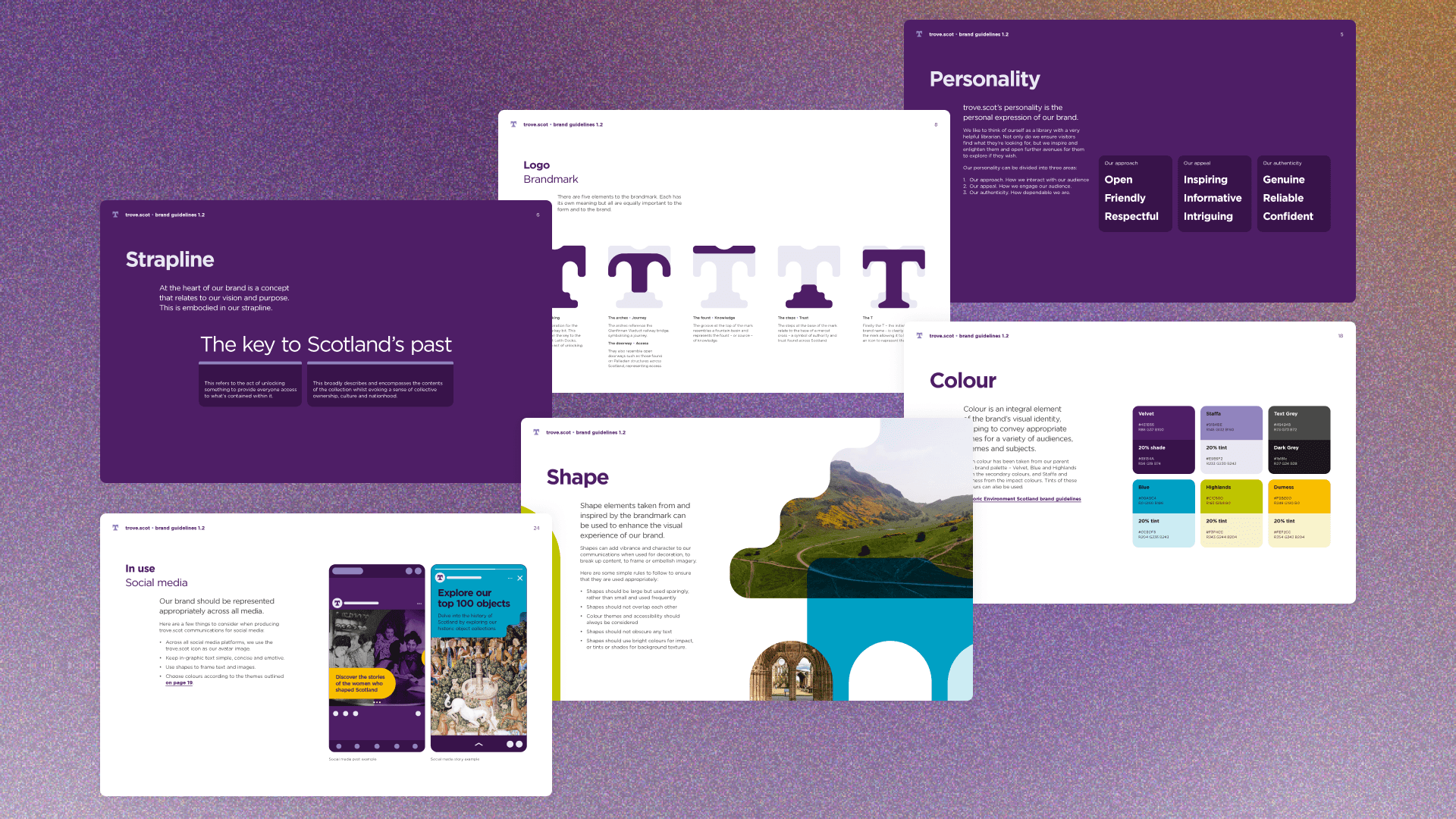
The brand story: We created the "trove.scot" identity, inspired by a historic T-shaped key found in the HES collection. It beautifully symbolises the act of unlocking Scotland’s hidden past.
Simplifying the audience: Through deep user research, we consolidated over 30 confusing legacy user profiles into six clear, practical archetypes to guide our design.
True accessibility: Built strictly to WCAG 2.1 AA+ standards, the platform passed the rigorous Digital Scotland Service Standard (DSSS) assessment, backed by over 100 strategic documents we co-created during the Discovery, Alpha, and Beta phases.
3. Governance through true collaboration
We didn’t just take a brief and go away to build this in isolation. Instead, we worked as a single, blended Agile team, embedding Manifesto specialists directly alongside HES experts to overcome institutional silos.
Together, we co-authored over 100 strategic documents to guide the project through the rigorous Discovery, Alpha, and Beta phases of the Digital Scotland Service Standard (DSSS) assessment. This joint effort ensured that the platform wasn't just technically brilliant, but fully compliant with public sector standards from day one.
Impact
trove.scot has changed how people interact with Scottish heritage. By focusing on Broadening Engagement, we intentionally designed a system to reach a wider, more diverse audience, bringing history straight into people’s everyday lives—helping a user discover old photos or the listing history of their own street. By launching trove.scot, HES directly delivers on its mission: to ensure Scotland’s heritage is cherished, understood, shared, and enjoyed with pride by everyone. This project uses modern digital tech to ensure that Scotland’s physical past remains a vibrant part of its digital future
-
Radical accessibility: For the first time ever, the public can access these 3 million HES records from one single, beautifully designed home.
-
Growing user base: In July 2025, the platform welcomed 73,282 active users—its biggest month since launch.
-
Meeting users anywhere: Over 50% of people now explore the website directly on their smartphones, proving the success of our mobile-first design.
-
Empowering content creators: HES experts are no longer just managing data; they can now easily write engaging, narrative-driven "Stories" that link directly to collection records, adding deep, rich context for readers.
What's next: The 2026 roadmap
Our success with trove.scot has evolved into an ongoing strategic partnership. As we look ahead through 2026, we are pushing the boundaries of the platform even further:
Expanding discoverability: Designing improved hierarchy display and adding thesauri search function to help users find what they’re looking for.
Integrating eCommerce: Collaborating with HES teams to make image licensing available, connecting trove.scot to a separate sales platform with a smooth user experience – supporting the archives while protecting the organisation’s public service mission.
User accounts: Exploring future plans to allow users to submit their own contributions and save their own ‘favourites’ and preferences, improving the user experience while helping the collections to grow and further document Scotland’s past.