Published December 11, 2025
The rise of AI and its impact on search behaviour
The constant developments in Artificial Intelligence (AI) are increasingly affecting both our personal and professional lives. From sophisticated AI agents and chatbots to the direct impact of AI on organic traffic, AI is fundamentally changing user behaviour at a rapid pace.
Users increasingly choose to search for your organisation using a Large Language Model (LLM) platform like Gemini or ChatGPT, or consume AI overviews without even realising they’re interacting with AI. As organisations operating in the digital space, we have no choice but to engage in Generative Search Optimisation (GEO) to remain visible in this new world.
In this guide, you will discover:
- What is Generative Engine Optimisation (GEO)?
- Why is GEO important for your organisation?
- Current state of AI Search and its impact on organic traffic
- The collapse of the linear marketing funnel
- How is GEO different from Search Engine Optimisation (SEO)?
- How to measure GEO
- Steps to implement to improve your AI visibility
If you want a quick summary, jump to:
What is Generative Engine Optimisation (GEO)
Generative Search Optimisation (GEO), often referenced also as Answer Engine Optimisation (AEO) or AI Search Optimisation, is the practice of optimising an organisation's online content to improve its visibility and citations across AI platforms and features like ChatGPT, AI Overviews, or Bing Copilot. The strategic objective of the practice is to be mentioned, cited, or summarised within these platform responses.
Why is GEO important for your organisation?
AI Search is causing a fundamental shift in user behaviour. After decades of browsing the internet using Google (or an equivalent platform like Ecosia) and navigating through "blue links," we are moving into an era of personalised conversational search using LLM platforms like ChatGPT, Perplexity, or Gemini, which is continuously improving the user experience.
We are seeing not only more and more people using LLM platforms to search for information but also more new products and features being developed to enable us to do so. AI Overviews (AIO) and AI Mode are perhaps the most prominent features brought to us by Google. While there are no definitive reports that provide insight into whether AIOs and AI Mode or LLMs impact organic traffic, our assumption is that AIOs have the most significant impact on organic search traffic now, but over time, it will be increasingly lost to AI chats like ChatGPT as the volume of users increases.
It is vital for organisations to respond to this shift as organic traffic continues to drop. While it is unlikely you will be able to recover the sheer volume of organic traffic you saw in the past, it is even more important to take advantage of the opportunity this shift presents.
What is AI Search
AI Search refers to a search experience powered by generative AI that summarises information, answers questions, and holds conversational context, often bypassing the need for a user to click through to websites.
What are AI overviews
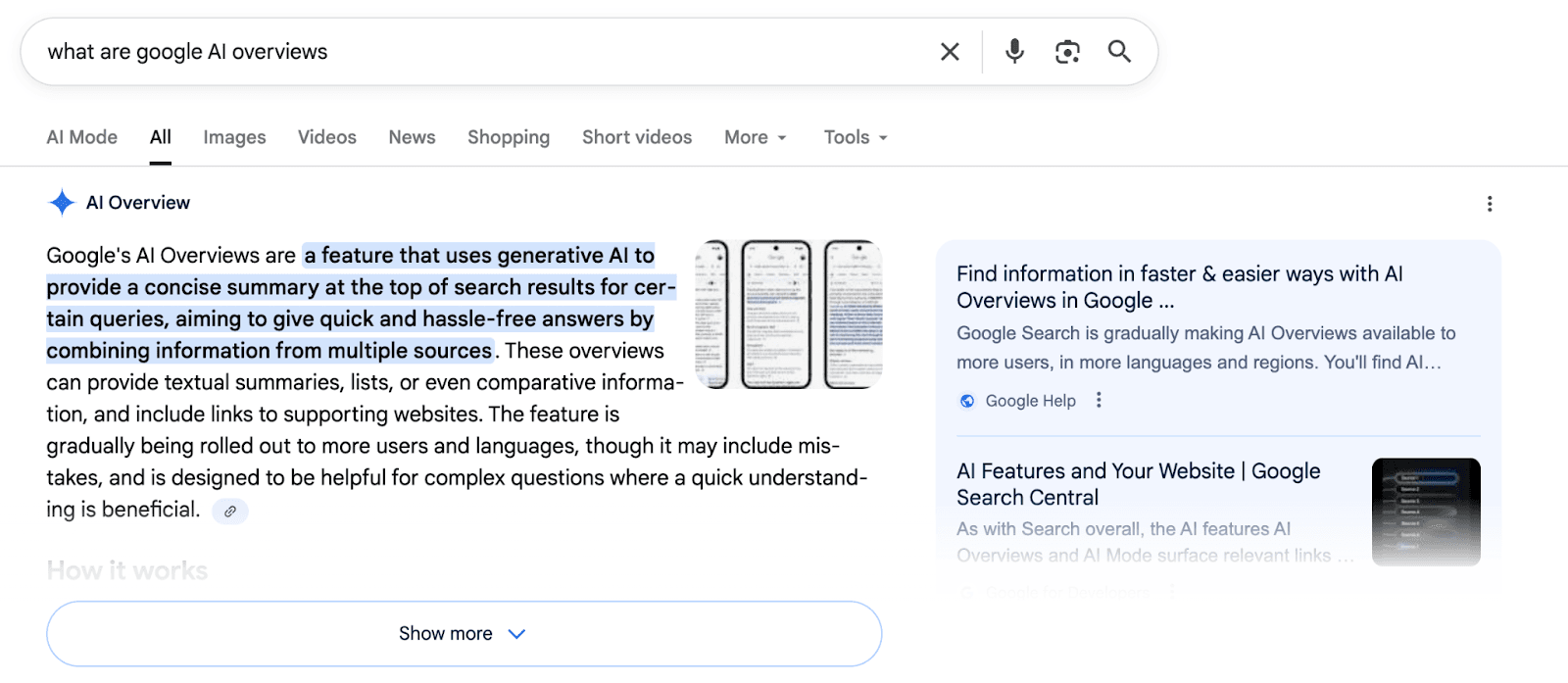
According to Google's own definition (via an AI Overview), "Google's AI Overviews are a feature that uses generative AI to provide a concise summary at the top of search results for certain queries, aiming to give quick and hassle-free answers by combining information from multiple sources. AIO also include links to sources used to provide the answer, potentially still driving traffic to sites for users who want to verify the information.

What is AI Mode
AI Mode and the Gemini experience in Google Search replicate the look and feel, as well as the capability, of a native LLM platform (like Gemini) by using generative AI to provide personalised answers in a conversational manner, offering users an improved search experience.
One of the key features of AI Mode is follow-up questions, enabling people to continue the search conversationally, with the AI maintaining the context of the discussion.
AI Search is becoming increasingly popular across the globe, leading to a noticeable drop in traditional organic traffic, which can be anywhere between 15 and 60% depending on the market and sector.
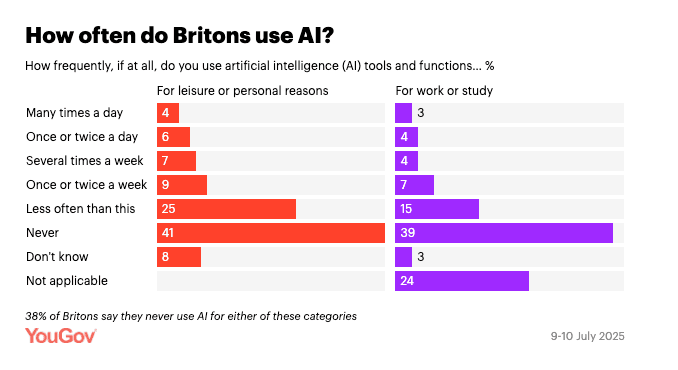
According to YouGov (2025), 10% of Britons use AI for personal or leisure reasons every day, and 26% use it at least weekly. While usage is increasing significantly, 38% of Britons still claim they never use AI for leisure, work, or study.
And while AI remains a source of information that is currently less trusted than traditional sources (YouGov , 2025), its growth trajectory cannot be ignored.
- By 2028, AI search traffic is predicted to surpass traditional search traffic (Semrush, 2025).
- Currently, about 18% of UK queries result in AI Overviews (Sistrix, 2025), with some studies showing even more rapid growth.
Rethinking the linear marketing funnel
The development of AI platforms and their impact on search behaviour have also fundamentally affected the way people make decisions, leading many experts to proclaim the traditional linear marketing funnel as 'flat.'
As people increasingly use AI search to access information, the instant synthesis through a single, complex query replaces multiple browsing stages in the traditional journey. Users using AI search can get their questions about a certain organisation or service answered in a personalised, proactive chat rather than showing content based on specific keywords.
As a result, consideration has become invisible as people no longer need to engage with traditional "middle-of-the-funnel" content. Decisions are often made within the AI models. Consequently, users enter the final stage of the journey much ‘deeper’ than they would traditionally, having already made a decision about how they want to engage with your organisation.
SEO vs GEO
As many in the sector have stated, GEO is an evolution of SEO, not its replacement. So, how do they differ?
Search Engine Optimisation (SEO) focuses on optimising websites for traditional search engines like Google, Bing, or Ecosia. The practice aims to get organisations to appear in the Search Engine Results Pages (SERPs) for specific keywords to drive clicks to the website.
GEO, in contrast, focuses on optimising content across the website as well as other public platforms like social media, so it can be easily found and repurposed by AI platforms for the specific intent of a user. The goal is for brands to increase their visibility in the platform responses through relevant mentions and citations.
Many claim that the intent of AI-driven traffic is therefore higher than traditional organic traffic, as users come to the site with a deeper understanding of the brand, further down the funnel than they typically would. According to SEMrush, the value of a person coming from an AI search is potentially 4.4 times higher than an organic visitor.
Amsive, a US-based commercial agency, developed a comprehensive guide that provides a useful breakdown of elements that are relevant for SEO, GEO, and those that apply to both:
Elements that are only SEO
These elements primarily serve the function of traditional search engines:
- Keyword research and optimisation: Focus on specific keywords, their search volumes, and ranking. E.g.: If you are a pet organisation optimising a page for the high-volume term 'sponsor a dog' keyword.
- Indexability: Improving traditional search engines’ ability to find your webpages.
- Crawl budget: Managing how search engines crawl your pages. This is only relevant for very large sites.
- XML sitemaps: Helping search engines find all website pages. E.g.: Periodically updating your sitemap to reflect the current live pages.
- Rank tracking: Tracking the ranking of specific keywords. E.g.: Measuring performance of the 'sponsor a dog' keyword.
- Core web vitals: Assessing page speed and performance. E.g.: Reducing the size of images that are not compressed to improve page speed.
Elements relevant for GEO and SEO
These are foundational elements critical for both traditional and generative search visibility:
Technical:
- Crawlability and rendering: Making sure your content is accessible to all crawlers (search engine bots and AI bots). E.g.: Allowing AI bots to crawl all or parts of your website via your robots.txt file.
- UX and readability: Making sure your site provides an optimal experience for your users and that the readability of your content is appropriate for your audience. E.g.: Making sure your Information Architecture is clear and logical.
- Structured Data & Schema Markup application: Implementing taxonomies (standardised code) to help machines understand the meaning and context of your content. E.g.: Implementing Schema Markup to all your articles.
Content:
- E-E-A-T Guidelines: Applying the Experience, Expertise, Authoritativeness, and Trustworthiness guidelines to your content. E.g.: Making sure your content shows true expertise through original research about the most pressing issues pushing pet owners to give up their pets.
- Multi-modal content formatting: Creating content that can be consumed in multiple formats. E.g.: Making sure you are uploading a transcript to your video focused on dog training.
- Focus on intent and semantic SEO: Understanding your user's true needs and behaviours. E.g.: If people come to your site to get information about dog training, make sure you have a top-level page for the topic as well as specific pages with in-depth information like how to teach your dog walk on a leash.
- Entity-first website structure: Organising content around key topics (entities). E.g.: Structuring your content around the advice for pet owners of the species you care for.
Offpage:
- Backlinks: Building authority and credibility signals. E.g.: Having a guest article published on a prominent pet owner publication’s website.
- Brand awareness across multiple channels and formats: Building a consistent brand presence across multiple channels. E.g.: Publishing your training videos on YouTube, too, or aligning your organic social strategy with your organic content strategy.
Elements that are only GEO
These are new, AI-specific optimisation tactics:
- Prompt-based optimisation: Optimisation for conversational search. E.g.: Writing in the second person, using ‘you’, to directly address the user's implied prompt. A good example is Unicef’s page on how to help Gaza
- Zero-click performance metrics: Focusing on measuring visibility without a direct reliance on website traffic. E.g.: Focusing on measuring mentions and citations in AI-generated answers.
- Monitoring LLM visibility and sentiment: Tracking mentions, citations, and sentiment in AI platforms and features. E.g.: Tracking mentions in ChatGPT and Gemini.
- Technical readiness for AI crawlers: Ensuring specific AI crawlers can access your content with maximum efficiency. E.g.: Minimising complex JavaScript on your site where possible.
- Implementing LLMs.txt metadata: Implementing emerging protocols to guide AI model behaviour. E.g.: Implementing a protocol like LLMs.txt to inform AI bots about content usage.
How to measure the impact of GEO
The impact of AI Search is currently predominantly tracked through visibility. Visibility in the context of GEO means the number of times a brand is named, referenced, or cited in AI Search results. In addition to visibility, measuring sentiment is also a key part of the assessment. This data is currently not available in GA4 or GSC, which only provide you with limited insight into the impact of AI overviews and LLMs on your organic traffic, and so an additional tool to provide insight is needed.
The key is not only to get the right insight but mostly to share the performance across relevant teams, including web, marketing, and brand, and integrate it in the strategy and tactics.
GEO metrics to focus on
A mention is defined as any case where a brand is named or referenced in an AI-generated response, even if a clickable hyperlink is not included. Mentions are believed to help boost awareness.
A Citation is defined as a reference, link, or source attribution in an AI-generated response. Citations explicitly use a source to attribute a fact to a brand. E.g.: "According to [organisation name] impact report..." Citations build authority and trust.
In terms of ‘traditional’ metrics, the volume of AI traffic to the site (the sum of any traffic to the site driven from AI platforms, including ChatGPT, Gemini, Perplexity, etc.), its engagement rate, and its impact on the site's overall Click-Through Rate (CTR) are also important to track.
Steps to implement to improve your AI visibility
The good news is that you do not need to start from scratch. You just need to evolve your SEO strategy, align it closely with PR and brand efforts, and implement some new, evolving AI search tactics.
1. Assessment of user intent and needs
The first step you need to take is to strategically assess your audience. Ask yourself what your audience truly needs and wants, and what their intent is when they come to your site:
- What are the different segments of your audience by different content types and user missions?
- What motivates them to seek you out?
- What purpose are they trying to achieve when they search for your site or related topics through LLMs?
- What are the current pain points in finding the content?
- What context are they searching? Are they exploring or experiencing high stress?
2. Performance assessment
Before you can start optimising, it is key to understand the current situation and how your competitors are doing:
- How much has your organic traffic dropped?
- What percentage of that can be attributed to AI search?
- What is your current brand visibility across AI platforms?
- How many mentions and citations are you driving?
- What’s the sentiment in your AI coverage?
- What topics are you dominating, and what strategically important topics are you currently not visible for?
- How are your competitors doing in comparison to you?
3. Technical recommendations to improve visibility in AI search
To assess your technical performance, you need to start with an audit. The audit needs to focus on both foundational technical SEO and the assessment of AI search tactics, like the reduction of JavaScript and the implementation of emerging protocols.
You want to assess elements such as:
- Access: Can the AI bot access your site?
- Security: Is your site secure (HTTPS)?
- Understanding: Can AI bots easily understand the meaning of your content? Are you implementing Schema Markup and protocols like LLMs.txt?
- Structure: Is the structure of your site clear, logical, and entity-based?
4. What kind of content should you write for GEO?
AI models value depth and completeness. Write content that anticipates and directly answers natural-language questions, with paragraphs answering clearly specific questions/themes your audience might have.
- Are you using clear headers?
- Are you providing definitive answers and ensuring your content is backed by original research, data, and expertise (E-E-A-T)?
- Are you providing real value to your visitors and answering their questions clearly?
- Are you focusing on strategic topics that align with your organisational strategy?
A good example is the RSPCA’s page about euthanasia. It’s part of the wider rehabilitation cluster, has a clear structure and provides in-depth insight into the topic with clear sections answering questions users might ask.
5. How to improve your authority through GEO tactics?
Backlinks are as important as ever. AI platforms assess the authority of a source based on established trust signals.
- Earn trust signals: Make sure your site is referenced by well-trusted sites, major publications, and high-authority forums like Quora and Reddit.
- Focus on quality: Earn links through guest blog posts on relevant, high-authority sites, PR releases, and the publication of high-value original research.
- Community authority: Try to grow the volume of reviews your organisation gets, as these contribute to the overall trust signal.
Interested in running an audit?
Risks and limitations of GEO
AI Search is still developing, and therefore, GEO strategies and tactics need to evolve rapidly with the sector. This makes the space inherently volatile and ever-changing.
While you should definitely be thinking about your GEO strategy, it might not deliver the immediate impact you seek. You should also be considering which platforms your audience uses and aligning your wider strategy with that. Are there any other channels you should be adding to your marketing mix?
Alongside this focus on your site's on-page performance. Is the conversion rate as good as it can be to make the most of the traffic that you are getting? Are there elements of your site, and particularly conversion pages (donation forms, sign-up flows), that need to be reviewed? Think about ways to capture more user data so that you can proactively communicate with your users and keep them in your ecosystem.
Think about a Conversion Rate Optimisation (CRO) strategy alongside your generative strategy.
A quick summary
Here is a handy summary of the key takeaways:
-
AI search is here to stay. Its impact on organic search is fundamentally changing the sector and user behaviour through personalised and improved user experience. And so it’s important to engage sooner than later, experiment and transform through iterative changes step by step.
-
You are unlikely to recover your organic traffic to the levels you saw in early 2024 but the good news is that this new era is mostly an evolution of modern SEO. You need to think about what already works well and is following best SEO practices, and what needs to be adjusted. Internally, it’s important to have honest conversations across teams, and acknowledge if targets and KPIs need to change.
-
Your audience's needs and motivations by content type and user intent should be at the forefront of your strategy. How can you meet your audience in the right place at the right time?
-
To develop a GEO strategy, you first need to understand its impact on your organisation. Consider getting a specialised tool to understand the full picture of mentions and citations or start with GA4 and GSC, we can help.
-
Assess your site's technical health and crawlability. If people or bots cannot access your site, even the best content in the world won’t be visible.
-
Review your content through the eyes of the user. Consider its structure, expertise, and freshness. Are you providing real value to your visitors and answering their questions definitively?
-
Focus on authority. Get respectful sites to link to your site through guest blog posts, PR releases, and original research. Try to grow the volume of reviews your organisation receives.
-
GEO alone won’t do the job. Integrate your marketing efforts, differentiate the channels your audience uses, and make sure your site is working for you as hard as it can with a focus on data capture and conversion.
-
Be curious. This space is growing and changing fast. Keeping up with the conversation, experimenting, and exploring will help you iterate and succeed.
-
Ask for help if you need it. This space is new to us all; talk to your colleagues, peers, or people online.
Do you want to develop a GEO strategy? Let’s chat.