
Challenge
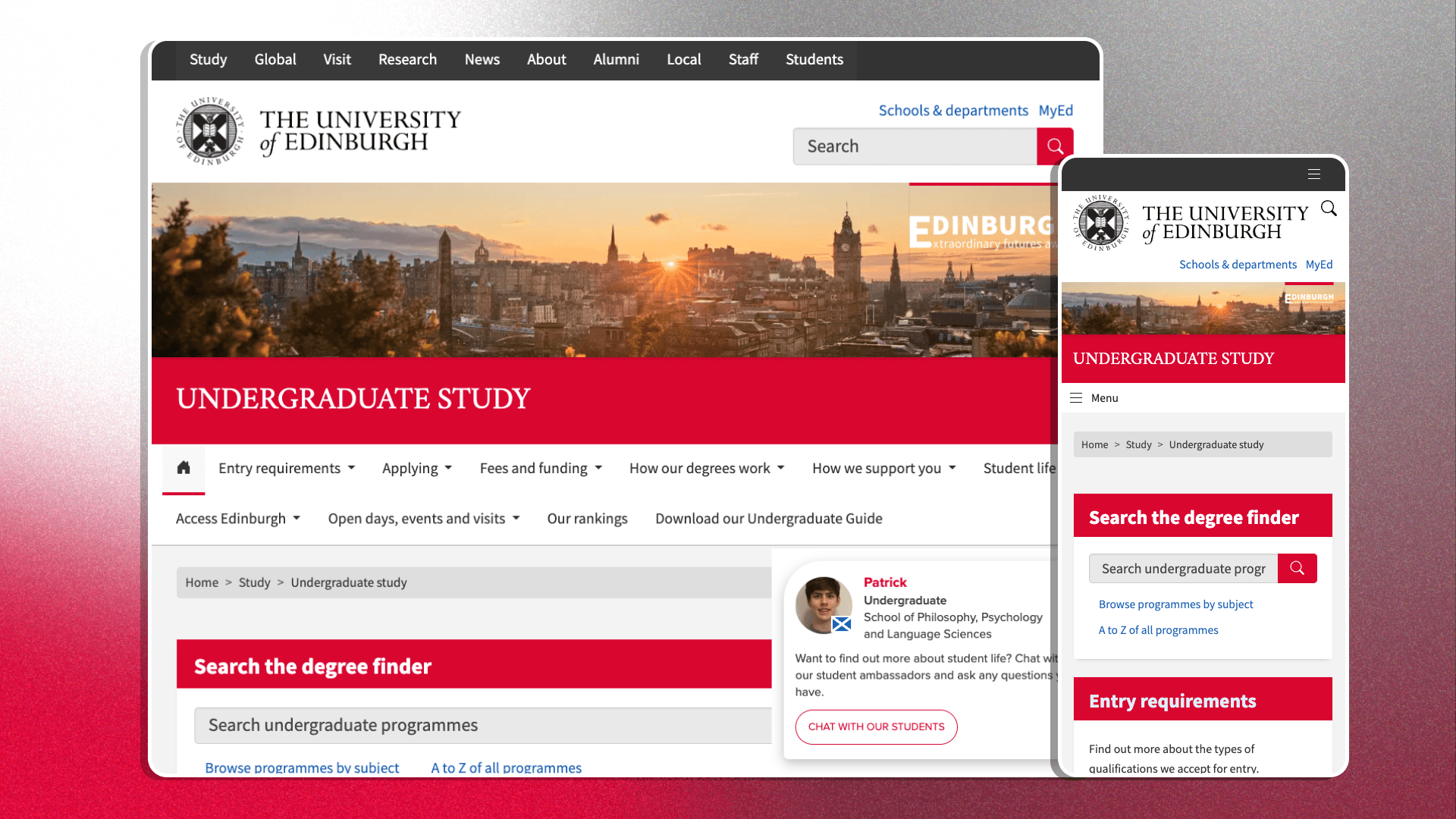
The University of Edinburgh’s Degree Finder is the primary gateway for prospective students, shaping first impressions and influencing application decisions at scale. By 2021, however, the platform was struggling to meet both user and organisational needs.
Prospective students found it difficult to answer basic questions on the site, leading to high enquiry volumes and reduced confidence in eligibility and entry requirements. Behind the scenes, the technology stack was outdated, with content models rooted in print-era thinking and workflows reliant on manual processes, spreadsheets, and legacy systems. As a result, schools and central teams created duplicate content across multiple sites to fill gaps, increasing maintenance overhead and inconsistency.
The University needed to modernise a mission-critical platform within a complex institutional environment, while continuing to support live recruitment cycles. manifesto was brought in to partner with the University’s Prospective Student Web team to reimagine the Degree Finder experience, redesign its foundations, and deliver a future-ready solution that worked for students, editors, and internal teams alike.
Solution
Manifesto worked as part of a blended, multi-disciplinary team alongside the University of Edinburgh’s Prospective Student Web team over a three-year programme.
The University had already invested significant groundwork before development began, including research, content auditing, and service design to shape a clearer vision for the future Degree Finder. When Manifesto joined at the start of year one, our priority was immersion and alignment. From the outset, we invested heavily in discovery and alignment, immersing ourselves in the University’s wider digital strategy, platform ambitions, and organisational constraints.
Working within this context required more than technical delivery. We helped translate strategic ambition into a clear architectural approach, establishing shared ways of working that would support a complex, multi-year build. That meant defining where functionality should live across platforms, setting collaboration rhythms that respected wider dependencies, and ensuring the Degree Finder’s unique requirements could evolve in step with the University’s broader EdWeb roadmap.
The solution centred on rebuilding the Degree Finder as part of a new studying site built on top of the University’s modern Drupal-based EdWeb platform. EdWeb is the University's redeveloped web publishing platform, built on Drupal, that was developed by the University’s website and comms team in parallel with Manifesto's work on the Degree Finder. The Degree Finder was the most ambitious new website being built on this platform so it was important that both projects stayed aligned, including identifying opportunities for mutually beneficial work.
We worked with the Prospective Student Web Team to design and implement highly complex Drupal content models capable of supporting hundreds of data fields, multiple programme types, and year-specific variations, while remaining performant and editor-friendly. Custom workflows were built to reflect real content operations, rather than forcing teams into rigid, out-of-the-box patterns.
Delivery followed an agile, iterative approach. A beta undergraduate experience was launched early to gather feedback, allowing the team to refine and improve before scaling. Close collaboration between development, UX, and content teams was supported through shared rituals, open documentation, and visual collaboration tools, enabling fast decision-making and continuous learning.
Throughout, testing, analytics, and user feedback loops informed prioritisation, helping the team balance long-term transformation with the realities of live recruitment cycles.
Impact
The new Degree Finder has seen 2.8 million visits in a period of 11 months since launch in March 2025 and is still growing. The Study site is the most visited part of the University of Edinburgh web estate, accounting for over 25% of all traffic.
It has fundamentally changed how prospective students explore programmes at the University of Edinburgh. By consolidating information into a single, authoritative experience, students can more confidently assess eligibility, understand course details, and make informed decisions, reducing unnecessary enquiries and wasted applications.
Internally, the University has significantly reduced content duplication (by 57%) and manual effort. A redesigned content model and Drupal-based workflows replaced weeks of copying and pasting with streamlined, automated processes, giving teams greater ownership and efficiency. The wider web estate is now leaner, easier to manage, and better aligned to user needs.
Since launch, the platform has handled millions of visits reliably, with frequent incremental releases delivering continuous improvements—something that was not possible on the legacy system. Perhaps most importantly, the project established a strong model for long-term, collaborative delivery across institutional boundaries, leaving the University better equipped to evolve the platform in the future.
Our project with Manifesto has established a strong model for long-term, collaborative delivery across institutional boundaries, leaving us better equipped for ongoing evolution of the platform.
Neil Allison, Head of Prospective Student Web University of Edinburgh
Being part of a collaborative development team with Manifesto was really rewarding, with manifesto developers embedded with University of Edinburgh staff, it really felt like we were all working as part of a single multi-disciplinary team.
Aaron McHale, Technical Lead for Prospective Student WebUniversity of Edinburgh