Before we start
In this article
What is an agentic CRM
Supporter experiences need to change
A brief history of CRM journeys
Two different supporter journeys in action
From journey maps to journey orchestration
Duty of care in the charity sector
Where is agentic being used in reality
Getting from Journeys 1.0-1.5 to 3.0
Summary
So what are agentic journeys
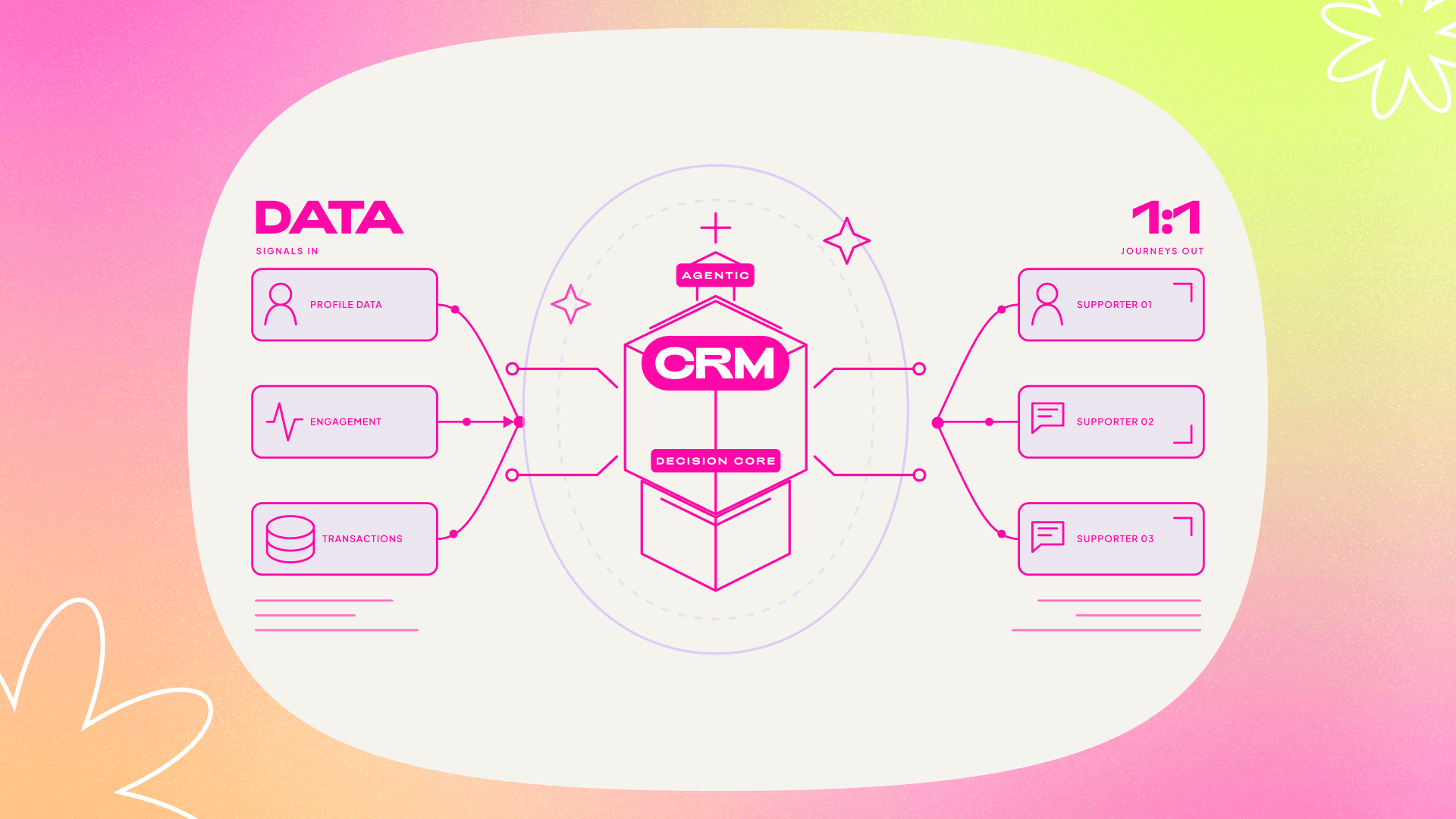
Agentic describes software that decides and acts toward a goal, rather than following instructions you wrote in advance. A traditional automation does exactly what you told it to. An agentic system is given an objective, a menu of approved options and a set of limits, then works out which option fits the person in front of it.
Agentic CRM is that idea applied to supporter communications. Instead of building the route in advance and hoping it fits, you write the policies, approve the content, set the limits, and let an agent decide what each supporter gets next.
In practice, that is the difference between "if someone opens but does not click, send email 3B" and "here are twelve approved things you could send, here is what you must never do, now decide what this supporter needs next".
It is not the same as automating an inbound query. This is a proactive decision about what to send someone who has not asked you anything, which is why the governance question matters so much.
I am writing this blog in mid July 2026, and even in the week I’ve written this, what is possible is changing. This marks a snapshot of what I am seeing right now, and an evolving thinking I will continue to come back to. This blog is not a finished manual of exactly how to do Agentic Journeys. The concepts come from a brilliant course and series I did with Tom Burell, who introduced me to agentic decisioning and what he has coined CRM 3.0.I took those ideas and put them to the test, by designing a real supporter experience in the charity sector with an agentic decision layer inside it.
I do strongly believe agentic decisioning is where things are going. Maybe naivety, but I have not heard much talk about it yet in the sector, so I assume the use of agentic journeys are not yet widespread.
I do need to say - applying AI in journeys is not risk free. It is not a promise of an unlimited pot of money. It will not, on its own, reverse the decay in supporter giving we have all watched happen. But it has intrigued me…
An awkward truth - our supporter experiences are not landing, and we need to change
We are not competing with other charities on experience. We are competing with the best experience a supporter has had with any company, anywhere.
You hear it in research. Ask someone, "can you recall an experience with a charity that has stood out to you?" and you get blank faces and head scratches. Ask "can you recall an experience with a brand that has stood out to you" and the answer comes easily.
Expectations have been set elsewhere, and they have outpaced what we give supporters. With AI, that gap is part of why supporter engagement is decaying, and it is the same decay commercial teams are fighting with AI-powered customer engagement. So why can brands do it and we cannot?
I spent my first career years as a media buyer. ‘Right message, right time, right person, right channel’ on many PowerPoint decks and stayed a pipedream, and hoped you didn’t get asked about it too much. With mature personalisation, even personalisation at scale, you might get the right message to the right person. Right time and right channel, and all four at the time? Forget it.
AI has renewed the possibility of meeting that old promise. Uber, Netflix and others are already starting to crack it, and the category now has a name, digital customer engagement. Non-profits are being outpaced right now.
AI is giving leading brands like Uber and Netflix rocket boosters, while we’re still in brick flip flops.
A brief history of CRM journeys
Journeys 1.0: lists and messages
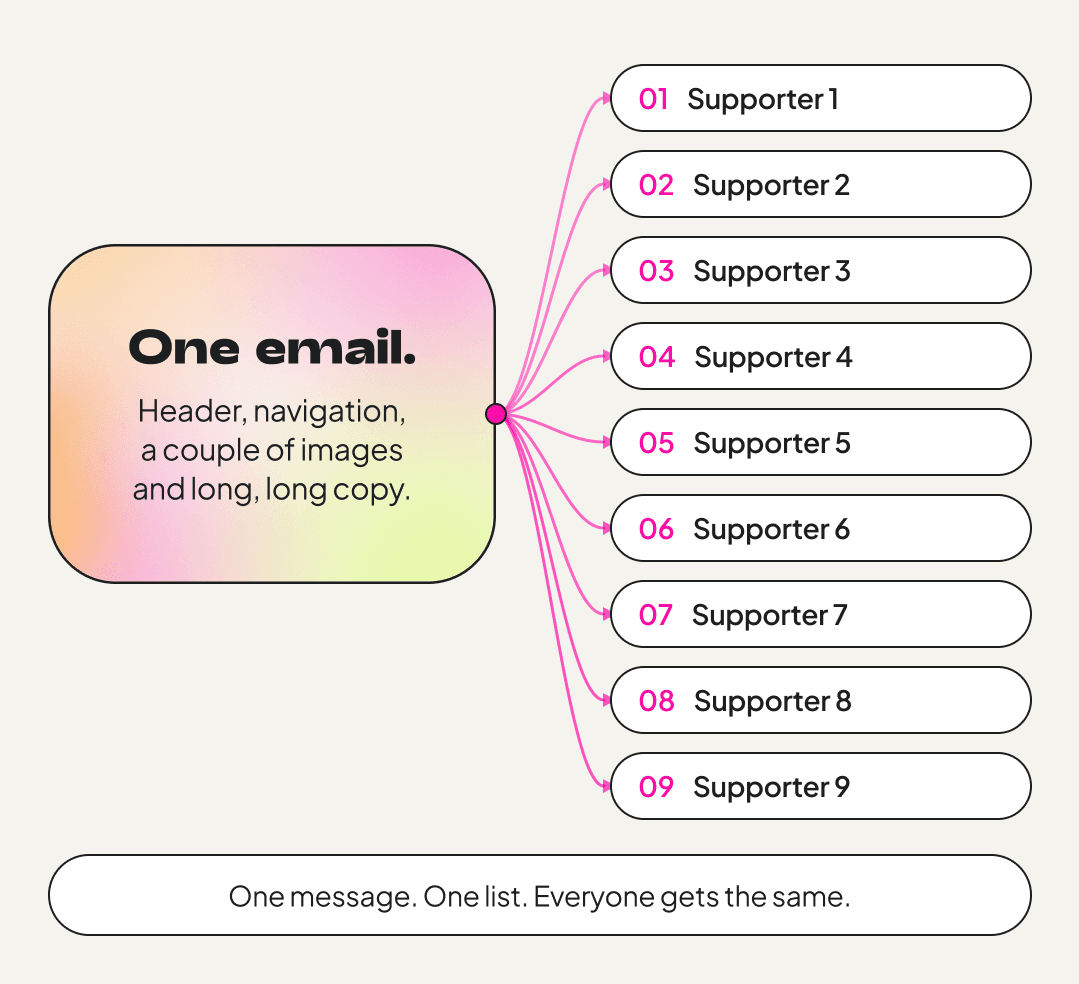
One message, one list. Usually manually downloaded and uploaded. (Diagram adapted from Tom Burrell)
This sequence is rarely triggered automatically. You might have planned it as a sequence on paper, but you set each email up as a single send. Everyone gets the same thing. The part you focused on was who received it.
It sort of worked. But, then again, we had nothing to compare it to.
Journeys 2.0: sequenced, structured journey maps
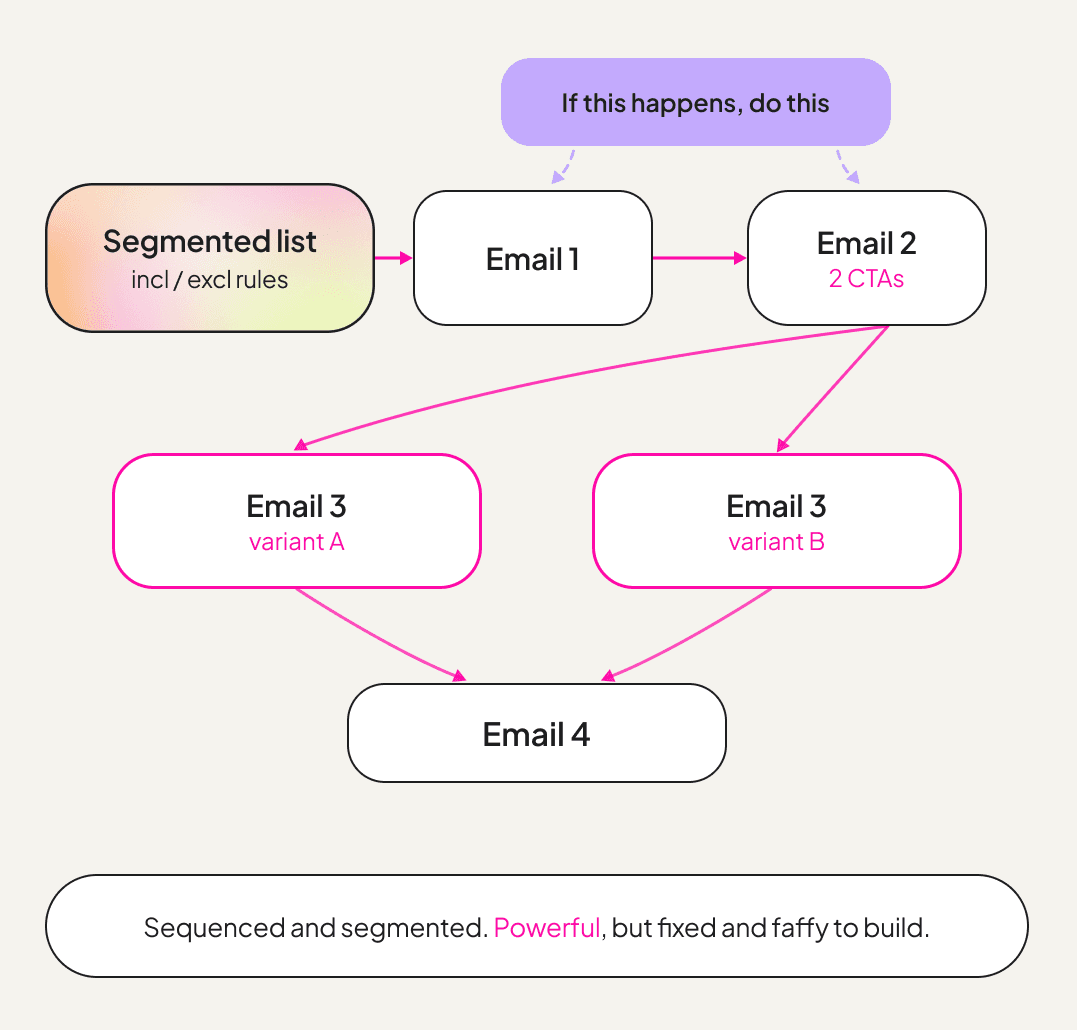
Journeys 2.0
Then the journey map arrived and this is where most of us are now.
Sending one message at a time was a pain, so we built sequences. Steps one to five, wait three days between. Then behavioural triggers. If opened but no click, send this. If they clicked donate but did not complete, do that.
We added segmentation and personalisation off the back of data. Identify someone with a particular motivation, place them in a segment, and branch them onto a journey built for that segment with content we’ve created tailored.
It works, and for most of us it is still where the value sits today. But it is mostly fixed, and the personalisation variants are faffy to build. I, like many colleagues wiring up these programmes, drew the nodes until it looked like a tapestry - this is what the industry now calls customer journey orchestration, done by hand. One arrow to the wrong place and someone gets a bonkers email. I have done exactly that, and I learnt the hard way.
The more ambitious it got, the more complex it got. Right person, right message, right time became sort of possible with a lot of effort and predictive sends. You might bolt on the right channel with predictive SMS, but how many channels have you actually got available? And did any of it go far enough to make data-driven decisions, or were assumptions still made?
Higher maturity brought more complexity. These journeys are a pain to configure on paper, let alone in Customer Experience Platforms.
Then there are the debates between teams. Who is really the priority? Who gets what? Frequency, what's the oversend threshold, is this journey logic even right?
Most of us are here, in 2.0. Some are still in 1.0 Some are somewhere in between.
Journeys 3.0: Agentic decision-making for one-to-one experiences
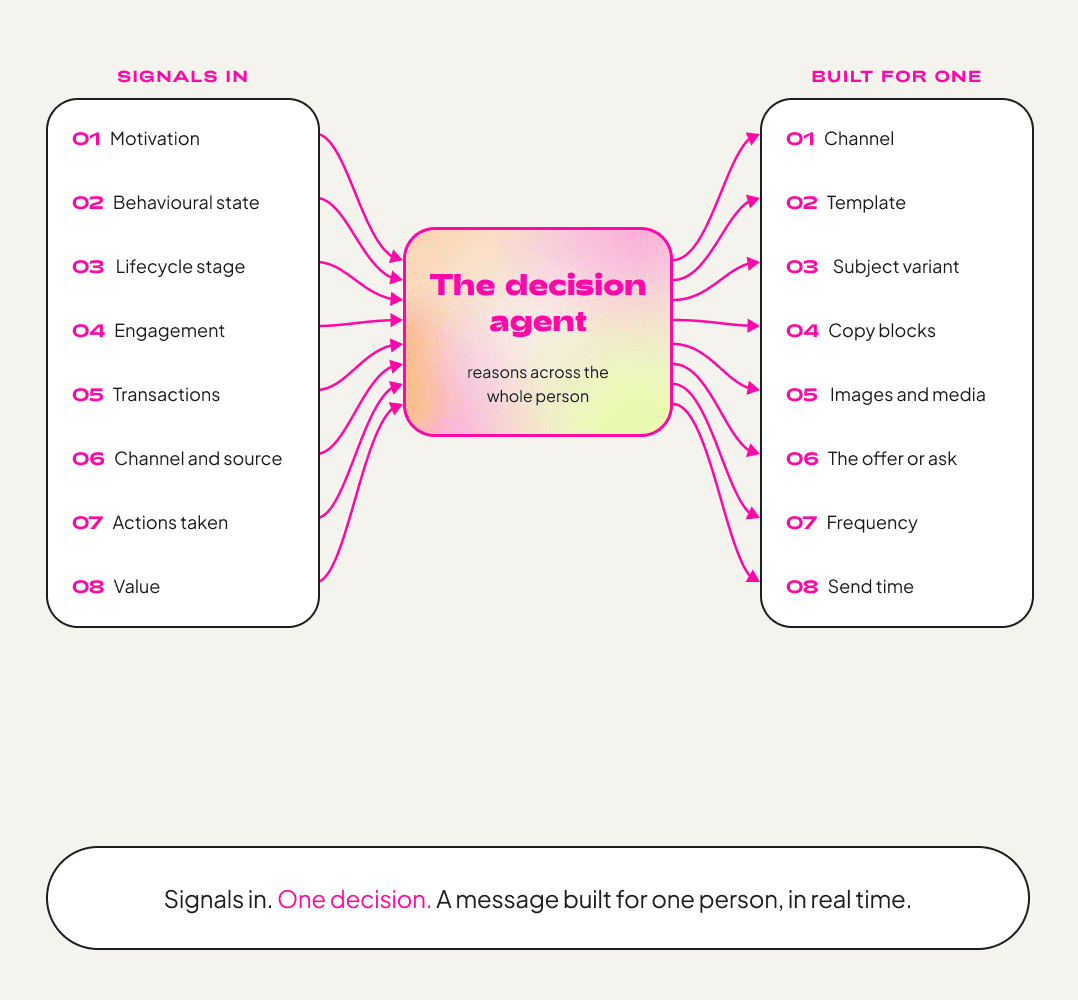

You collect data on your supporter, and we call these signals. Those signals sit against an identifiable supporter record. Those signals feed an agent that reasons across the whole person and decides what happens next. This is AI decisioning, sometimes called customer decisioning: the decision is separated from the send. We design the rules, policies, and inputs and audit the decisions the agent is allowed to make.
This is what the commercial sector means by AI-powered customer engagement, and it is the old promise finally met. Right message, right time, right person, right channel. Journey can be one-to-one. Every supporter gets a different path based on their data which is bespoke to them, in real time. Lovely stuff.
I am not promising journeys 3.0 is better, or easier. But the effort is in a different place. We are spending our time configuring changes. Now we spend it designing our experience strategy which informs the rules, the policies, the decisions and the menu of choices.
Will every journey eventually run completely autonomously this way? Hard to say, and not at first. But we can start where the problems are the biggest for both the supporter and for us internally, and the decisions are hard. For me, that is when the right time is for the Ask.
It sounds unbelievable. Probably a bit confusing too. So let me bring it to life with two supporters.
Two supporters, two very different journeys
Amara signs a petition for animal conservation from a TikTok ad. She gives her name, email and phone number, and tells us she acted because she wants governments to step up.
Amara gets a thank you that references why she acted, shows what past petitions have achieved, and makes clear her voice drives change. She gets a run of relevant messages, one on WhatsApp, and later sees an ad. She opens everything, because it feels bang on what she cares about. Two months in, she gets a cash ask. She gives.
Daryl donates £50 from a letter in the post. He gives his name, email and phone number, and tells us he acted because he wants long-term change for animal conservation.
Daryl gets a thank you that references why he acted, but he skims. He notices it feels relevant. He likes the subject lines and thinks they seem on it. He follows the social accounts. A few months later he sees an ask on social, this time to join a webinar with a programmes officer running a conservation Q and A. Now that is more like it. He signs up.
Same backend. Two very different journeys, each shaped by the person.
Both experiences run on the same decision-making layer. An ‘Ask Agent’ takes all the signals on the supporter and, through policies we have written, decides when to ask, what to ask for, how, and where. Every option comes from a pre-approved list. The agent picks what fits the person in front of it.
Amara's signals say she is a keen bean, highly engaged, restless, and wants government action like yesterday. So she gets an immediate ask, built from content tagged as urgent and government focused. Daryl's signals are a little less keen, so he gets a slower route and a softer entry point.
Think of it as a decision layer inside a 2.0 journey. You keep your personalisation and your behavioural triggers in a journey map. But when a choice comes up that a behavioural trigger cannot handle well, the kind of call real-time decisioning exists for - one that needs a call made on the individual- that is where an agent earns its place. The journey map does not disappear, yet. Its job changes, from a fixed route into a set of policies and boundaries you set and govern.
So how is it actually done? From journey maps to journey orchestration
Here is the tech, end to end.
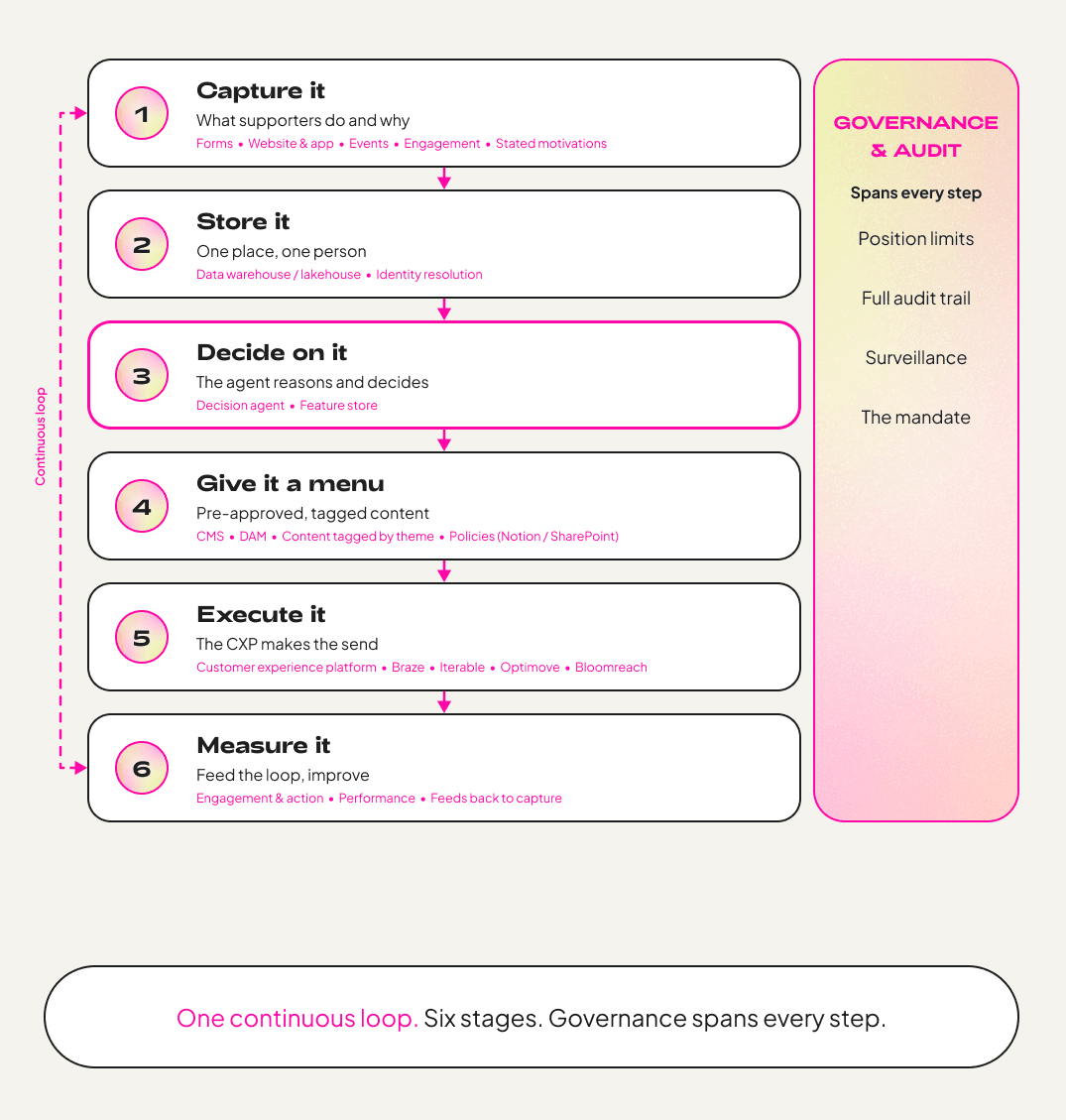
Journey operating loop
Capture what supporters do and why. Store it in one place so you know one person is one person. Let the agent decide. Give it a menu of pre-approved content to choose from. Execute the send through your customer experience platform, the journey orchestration layer most teams already own. Measure how it landed and feed that straight back in. That loop is what turns a set of sends into customer engagement automation rather than a smarter mailing list. And audit the lot, which in our sector is the part that matters most.
How it is governed: the trading desk
The framing in this section comes directly from Tom Burrell's work, and I am so grateful for how it’s explained, as my brain only really works in analogies. So governance of an agentic CRM borrows the discipline of a trading desk with thousands of automated decisions, high stakes, and it [mostly] does not run wild, because a human sets tight controls and watches them.
-
Guardrails it cannot cross. Hard limits you set that the agent cannot break. How often anyone can be contacted, what it is allowed to offer, and who must never be asked. A trader would call these position limits.
-
A record of every decision. Every choice the agent makes is written down, so you can always go back and see what happened and why. Which supporter, when, on which channel, the signal that prompted it, the content it used, the checks it passed, and the policy behind it. On a trading desk, this is the blotter. For us, it is how you explain any single message to a supporter.
-
A view across everyone, not just one person. Do not only spot check individual messages. Look across your whole supporter base, because the patterns are what catch the problems. Who are you contacting too much. Which group has the agent quietly gone silent on? The extremes are where it goes wrong, and you only see them at the population level. On a trading desk, this is compliance watching the whole book.
-
Care over what you tell it to chase. The agent will optimise for whatever goal you give it. Tell it to maximise donations and nothing else, and it will hound people. So you set the goal carefully, add a limit that stops supporters being over-asked, write it down, and review it over time. A desk would call this its mandate. Most bad behaviour traces back to a goal that was set without enough thought.
But this is fundraising, and we have a duty of care
Commercial sectors are running at this. But important to acknowledge the charity sector is different.
An agent that decides when and how much to ask is making calls that touch donor vulnerability, consent and trust. We carry an extra duty of care that a retailer does not. We have a Code of Fundraising Practice, a Fundraising Regulator, and a sector memory of what happened when asking went wrong. Getting governance and rules right matters more, because the decisions happen faster and at scale.
The reassuring part is that good governance answers most of this, if you build it in from the start. Your policies encode your duty of care. Your suppression rules protect people who should not be asked. Your frequency caps stop the oversend at every point in the supporter journey. Your audit trail lets you explain any single decision to a supporter, a trustee or a regulator.
And you do not hand over the keys on day one and be like off you go! You let the agent make decisions, and you review them before anything goes live. Would you have made the same call? That question, asked honestly and often, is the difference between agentic done well and agentic done to your supporters.
Gartner make a similar point from the commercial side. They say this shift moves marketing from engagement metrics to trust metrics, and that it demands stronger data governance and real transparency about how data is used. In our sector, trust was always the thing we need to protect and grow at all costs.
Is this Black Mirror fantasy land? Inside the agentic era
In short, it’s not. It is happening, and plenty of commercial organisations are moving at pace.
Gartner predict that by 2028, 60% of brands will use agentic AI to facilitate streamlined one-to-one interactions. Although many of these early agents are expected to be retired or rebuilt. That does not change the direction of travel.
Netflix and Uber already run this
Both have shared the engineering behind their messaging publicly. The decision is separated from the send, which is the defining feature of AI decisioning, the frequency is governed, and the decision layer moves instructions and references rather than creating the content.
Netflix run a slow policy and a fast policy. An offline planner builds a weekly pacing plan for each person, weighing the value of reaching out against the cost of another message. A real-time engine then checks that plan at each moment and, if it is cleared, picks the best message and artwork right then. The artwork is chosen at the point of sending, never fixed in advance.
Uber build content in a modular way. An email is a set of slots - subject, pre-header, banner and body. Models predict how likely someone is to open, and assemble the best mix for them. A real-time store of signals applies live overrides, so something like a location change can instantly update the offers in the queue. The system never writes to the user freely. Everything it sends comes from approved parts.
We are only at Journeys 1-1.5, can we leap to 3.0?
Yes and no. You do not have to live through all the years of pain of 2.0 to get here. But you do have to take data seriously and invest in it.
Put in less polished terms: Sh*t in, sh*t out.
Here is the things you can do to start
-
Openness to try. Change is the hardest barrier. If supporter experience is not valued as a priority, and I mean a real culture of supporter centricity with a shared sense of who your supporters are and why they hold your mission, the tech will not save you.
-
Data captured, stored and used. If your supporter data is spread across systems with no identity resolution, no CRM journey you build on top of it will hold - this is the thing to take seriously and invest in first. Most charities are years and real money away from this, and that is the honest truth.
-
A serious engagement strategy. Who your supporter is, what you know about them, what they need and expect. The commercial sector calls this a customer engagement strategy; ours has a duty of care built into it. Your policies flow from this, and they exist to benefit the supporter and protect the organisation.
-
Know where your biggest issues in the journey are. The make or break moments that are breaking now and would matter most if fixed. I picked the Ask because I have been designing for it. Yours might be churn if you lose more regular givers than you gain. It might be the thank you in your first welcome. Audit your end-to-end supporter journey and find where you lose the most momentum.
-
Play with building the agent, but just test it to yourself. Let it make decisions about customer records, but you audit them. You do not have to activate anything. Just watch how it decides, and ask whether you would have made the same calls.
Summary - how are you feeling?
This is mostly early thinking. It is also a strong signal that the commercial sector is about to raise the bar on experience again.
We are the charity sector and do not have to follow, or copy it exactly. But also we cannot bury our heads in the sand and hope for a different future.
A useful concept I’ve thought about here is futures thinking. The probable and plausible future, the one we drift into if we do nothing, is one where the experiences people have with brands are completely outpaced. Gartner put that at 2028. Not even the Euros will have come round again by then.
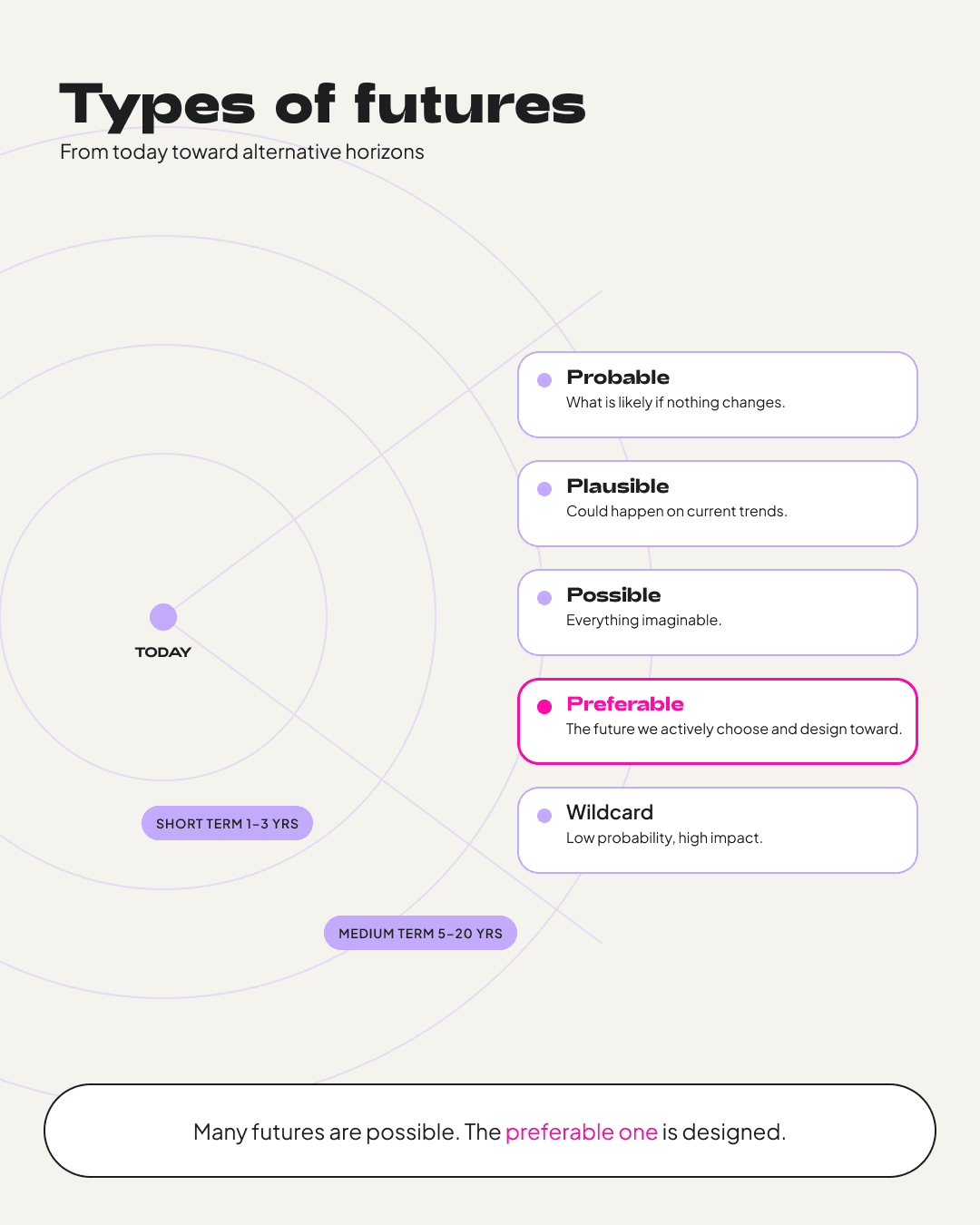
Agentic customer journeys are not a finished product, and the sector version, agentic supporter journeys, does not exist yet. That is the point. Preferable is the future we actively choose and design toward. It will only arrive by a shared decision about what we want, and the commitment to work to it.
It is weird, sure. But it is happening, and we have agency.