
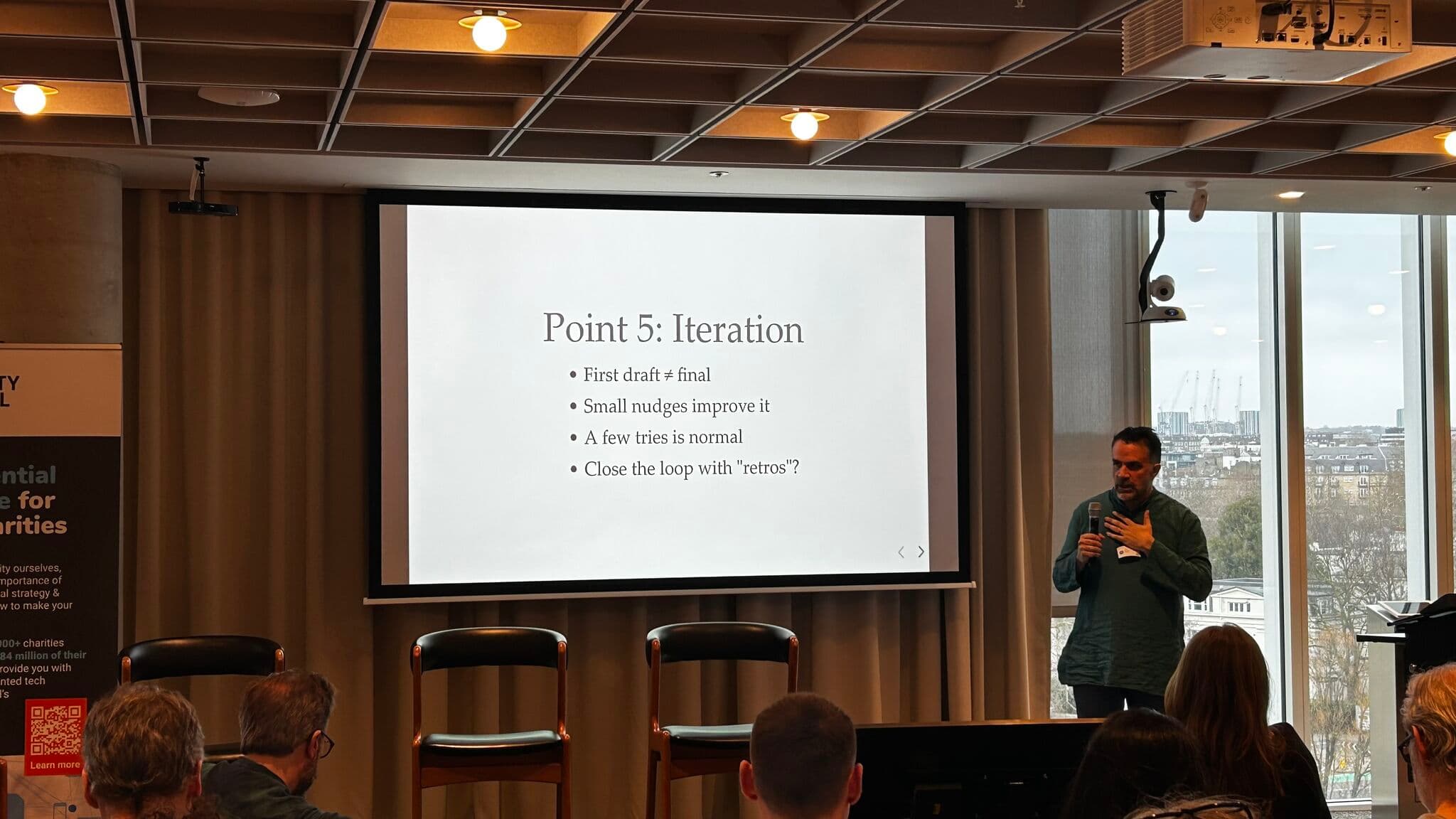

On Thursday 12 March 2026, we attended the Charity Digital AI Summit, a day dedicated to moving beyond the buzzwords and into the practical, ethical, and transformative reality of Artificial Intelligence. Whether you joined as an "AI whizz" or someone just starting to explore the possibilities, the energy in the room made one thing clear: our sector is ready to master the tech of the decade.
From deep dives into AI governance with experts like Zoe Amar and Matt Haworth, to hands-on sessions on reducing digital carbon footprints and automating donor engagement, the summit was packed with "aha!" moments.
If you couldn't make it, or if you were there and want to recap the highlights, we’ve rounded up the five key takeaways that every charity professional needs to know to stay ahead in 2026.
What is AI good at for charities?
AI tools are genuinely useful for a wide range of content and communication tasks-writing first drafts, summarising, brainstorming, translation, and reformatting information. Amit Kohli, Head of Data Insights at Access Social Care gave practical tips on getting better results through structured prompting frameworks, particularly relevant for teams with limited time or AI experience.
Here are some caveats though:
Hallucinations: AI output is not guaranteed to be factually true. It can sound highly convincing while being wrong. Any output that relies on accuracy - quotes, data, claims about specific organisations - must be verified by a human before use.
The Summarisation Trap: When feeding AI a long document to summarise, it does not read every word. It analyses what it deems sufficient to generate a response, with no indication of how much of the source material it actually reviewed. For high-stakes documents, this is a meaningful limitation.
Practical tip: Starting a new chat, rather than continuing a long thread, often produces faster, cleaner, and more accurate results. When a conversation drifts off-topic or the model keeps reverting to outdated context, a fresh start is usually more efficient than trying to correct course mid-thread.
AI is transforming website development - but the wins look different by the size of the charity
AI has fundamentally disrupted the old trade-off of "good, fast, or cheap - pick two." Increasingly, organisations can pursue all three at once. But how that plays out depends significantly on where a charity sits in terms of size and resource.
For small and medium charities, the most immediate gains are in coding and development. One speaker from a very small charity described how integrating AI into their dev workflow allowed them to move dramatically faster, amplifying impact that would otherwise have required a much larger team. Hand-coded sites built without AI assistance are quickly becoming the exception, not the standard.
For larger charities, the opportunity scales up to system-level improvements: using AI to audit sites for accessibility issues and generate corrective code, adopting Generative Engine Optimisation (GEO) by structuring content with LLM-friendly formats like Markdown and Schema markup, and producing AI-generated reports on site health, covering performance, security and accessibility.
AI has fundamentally disrupted the age-old trade-off of picking two out of the three “good, fast, or cheap" Increasingly, organisations can pursue all three at once. However, the way this plays out depends less on technical capability and more on the size and agility of the charity.
-
For small and medium charities: The most immediate gains are found in agility. With fewer layers of bureaucracy, smaller teams are using AI to bypass traditional bottlenecks. We heard how integrating AI into development workflows allows tiny teams to draft robust digital policies and ship code at a speed that previously required a massive agency budget. For these organisations, AI isn't just a tool; it’s a force multiplier that lets them move "dramatically faster" than ever before.
-
For larger charities: The potential for scale is enormous, but the journey is more complex. While they have the resources to implement advanced system-level improvements - such as using AI to audit accessibility, adopting Generative Engine Optimisation (GEO), and generating real-time site health reports—they also face significant governance hurdles. For a large charity, "moving fast" must be balanced against rigorous risk assessments and multi-departmental sign-offs.
Prompting frameworks worth knowing
Using a prompting framework can help get better outputs from Generative AI. A structured prompt can save time for the prompter while providing clear context and constraints to the LLM. This can lead to less back and forth conversation with the LLM. At the Charity Digital lightweight frameworks were shared to make prompts more reliable and reduce iteration time.
METHOD helps when you want to be explicit about the shape and purpose of output:
-
Motive - why are you doing this?
-
Expectations - what exactly should the output be?
-
Tone - professional, accessible, technical?
-
How - what format: bullet list, email, guide?
-
Output details - word count, constraints, things to avoid
CRISP-MAT focuses on context and role:
-
Context - background the AI needs
-
Role - e.g. "You are a fundraising strategist for UK charities"
-
Instruction - what should it do, concretely?
-
Scope - boundaries and constraints
-
Purpose - why you need this and how it will be used
Both frameworks are particularly valuable for teams new to AI, helping reduce back-and-forth and making prompts easier to reuse and share across colleagues.
Governance and the risk of shadow AI
Responsible AI implementation was another thread, with a clear message: governance needs to match the level of risk involved - and that applies to charities of all sizes.
Not all AI use cases carry the same risk. The summit outlined a rough risk hierarchy:
-
Unacceptable/very high risk - e.g. medical diagnoses involving personal data
-
High risk - e.g. hiring, finance, law enforcement; requires strong governance, transparency, and human oversight
-
Limited risk - lower-stakes uses with simpler transparency requirements
-
Minimal risk - e.g. spam filters or basic recommendations
For all charities, foundational elements like data governance and usage policies are essential before deploying AI. Charities handling sensitive or personal data sit in the higher risk tiers and need proportionate controls in place.
A practical governance model shared at the event (grounded in the Microsoft 365 ecosystem) emphasised five layers: strategy and leadership, data governance and security, people and change management, application and innovation, and critically, continuous monitoring of usage patterns, incidents, and long-term drift. Responsible AI is a lifecycle, not a launch.
Caveat - Shadow AI: A significant and underappreciated risk across the sector is the confidence and skills gap among staff. Many employees "don't know where to start" with AI, and in the absence of clear organisational guidance, they may turn to unsanctioned tools. This "shadow AI" problem can undermine even well-designed governance frameworks. Without visible organisational leadership on AI, the vacuum tends to get filled informally — and inconsistently.
What this means for the charity sector
Across the day’s discussions, a few themes stood out as being particularly critical for the future of how charities operate:
-
AI-assisted delivery is the new baseline: Charities—especially smaller ones—will increasingly expect faster, better-value digital work. AI has moved from a "nice-to-have" to an essential tool; teams that fail to integrate AI into their development and content workflows are already facing a competitive disadvantage in terms of efficiency and impact.
-
Prompting as a strategic necessity: Prompt literacy is no longer just a "techie" skill - it is a core competency for everyone from content creators to operations directors. Mastering the frameworks mentioned above isn't just about getting a quick answer; it's about deeply understanding how to communicate with AI to extract high-quality, nuanced, and brand-aligned results. When teams understand why they are structuring a prompt, they unlock the ability to turn AI into a genuine strategic partner rather than a simple text generator.
-
Governance as the foundation, not an afterthought: Perhaps the most vital takeaway is that governance must be the starting point. For any AI solution, whether it's an internal tool or a donor-facing chatbot, the framework of accountability must be established before the technology is deployed. This means explicitly classifying risk levels, defining who is responsible for the AI’s decisions, and building in "human-in-the-loop" monitoring. True accessibility and ethical safety only happen when governance is designed into the DNA of a project, rather than being a checklist used after launch.
The picture that emerges is of an AI future that is pragmatic and human-led. Charities of all sizes have a unique opportunity to amplify their impact, provided they approach adoption with equal parts technical curiosity and rigorous governance.