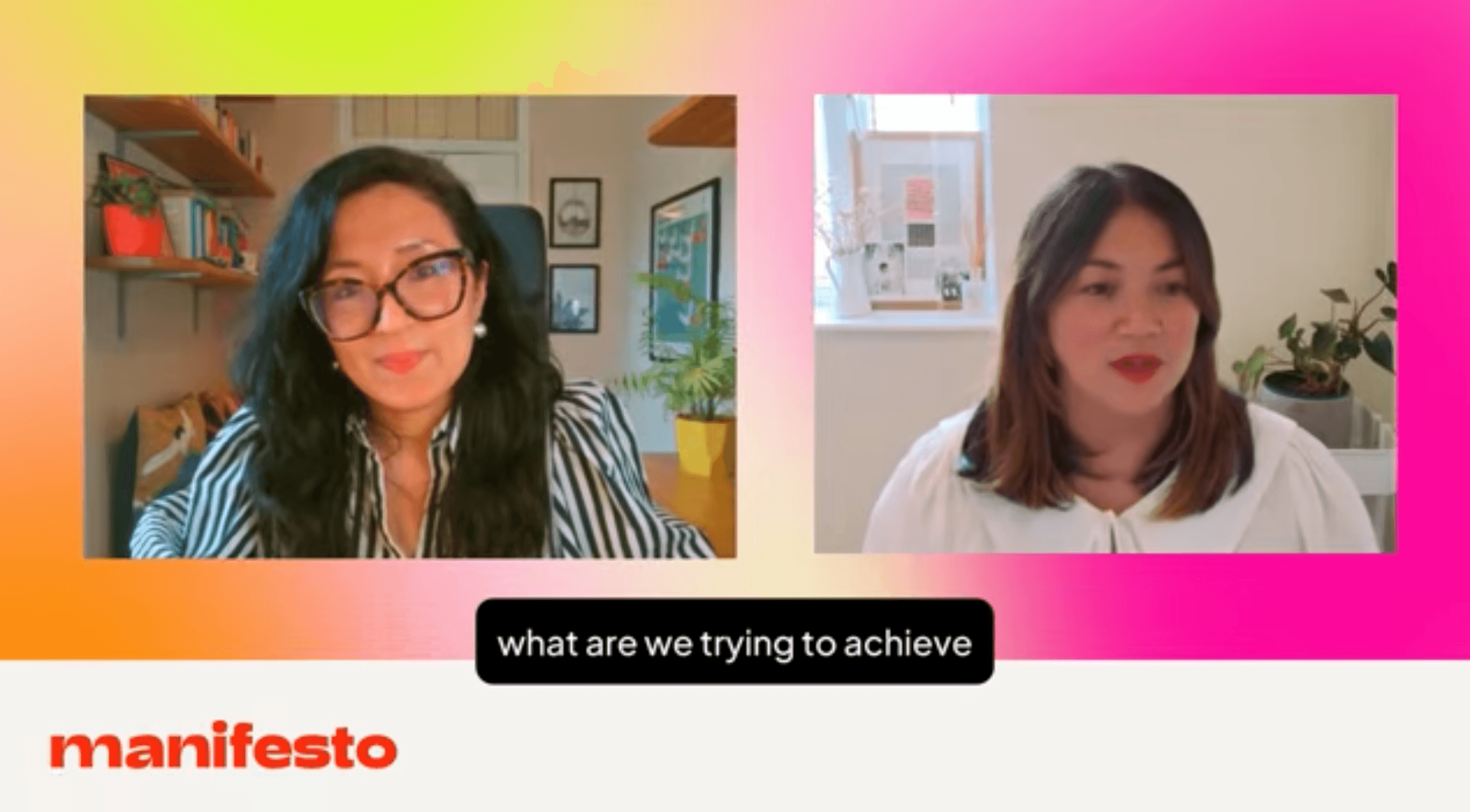
It was an absolute pleasure to sit down with Zoe Amar recently to reflect on the findings of the latest Charity Digital Skills Report. Having tangible, data-backed insights from over 800 participating organisations is vital for our sector as we navigate an increasingly complex digital landscape.
Here are my main takeaways and personal reflections from our conversation on where the charity sector stands, the hurdles we face, and how we can move forward together.
1. AI adoption without direction: Excitement vs. reality
One statistic that immediately struck me, and honestly sounds a bit terrifying on the surface, is that while 77% of large charities are excited about AI's potential, only half feel they are actively responding to it. Worse yet, 92% feel adoption isn't happening in a strategic or structured way.
I asked Zoe what sits inside this gap between high excitement and low strategic direction.
Zoe observed that while there is massive energy and pace around AI, much of it masks deeper uncertainties:
"Energy and growth looks like confidence, but talk to teams and you find that behind the scenes... people are perhaps less sure about what their charities' priorities are and what they need to do differently in order to deliver on them." — Zoe Amar
She highlighted the urgent need to get everyone, from senior leaders to junior staff and volunteers, on the same page regarding where to focus AI efforts.
From my perspective, AI acts as another forcing function. It forces organisations to ask fundamental questions: What are we actually trying to achieve, and what role does technology play in those outcomes?
2. Governance is more than just a document
We expanded on the idea of creating safe "guardrails" for AI. It is easy to view governance as a checkbox exercise that ends once a policy document is written, but both Zoe and I agreed it requires a much broader ecosystem of support.
Zoe pointed out that a policy must be reinforced by continuous manager support, practical training, and alignment with wider organisational goals so it doesn't end up in an isolated silo:
"You really need to reinforce what the policy is saying in terms of training, in terms of how managers might need to work differently... and above all, how you align your AI governance with your wider organisational governance so it doesn't end up in a silo of its own." — Zoe Amar
3. Defining success: Value created vs. pure efficiency
When we touched on measuring the ROI of AI and digital projects, I noted how difficult it can be for charities to measure capacity or workload gains internally.
Zoe shared a crucial mindset shift that boards and leaders need to adopt—moving away from pure cost-cutting to measuring value created:
"Increasingly, what we're seeing is organisations starting to think about value created, not just the amount of time or money saved... There's very little fat to cut in a lot of charities now. Everyone works in such a lean way... so that's why we have to be really careful, otherwise it could become a real race to the bottom." — Zoe Amar
She framed AI as an additional "thinking partner" or team member that allows charities to execute new ideas and expand reach that otherwise would have been impossible with existing staff capacity.
4. Facing the headspace and capacity deficit (and the art of "sunsetting")
In all my work with charities, I have yet to meet an organisation that says, "Lou, we have too much budget and too much time!" Capacity and headspace remain major bottlenecks to meaningful change. Framing an AI strategy isn't something you can squeeze into 15 minutes between back-to-back meetings.
Zoe stressed that innovation requires giving people the "space to think and the grace to fail."
This led us to discuss a concept my colleague Zoe Gerbier (one of our Principal Consultants) and we’ve been talking a lot about within our strategy function: Sunsetting. To create space for new initiatives, charities must actively decide what activities to stop doing.
Zoe recommended a dispassionate, portfolio-driven approach to help overcome the emotional attachments we naturally form around long-standing projects:
"We encourage charities to take a real portfolio approach. To look at what are the big bets, what are the things that are going to be on the back burner, and what things they're going to bin... Having some really strict criteria... then people feel empowered to be a bit more dispassionate about why they're doing things."
5. Bridging the skills gap at the board and leadership level
We spent considerable time discussing leadership and governance talent. The report revealed an interesting tension: 38% of charities want a dedicated digital trustee, while 40% want existing leadership to simply learn more.
Zoe emphasised that upskilling cannot be viewed as a transactional commodity (e.g., sending people on a one-off prompt engineering course and handing out certificates). It requires an environment where leaders feel supported in building their confidence:
"We really need leaders and boards to get behind the fact that the world is changing... Leaders have a responsibility, and boards do as well, to grow their own skills and start making decisions in partnership with their staff." — Zoe Amar
Regarding trustee recruitment outside the sector, Zoe cautioned that while bringing in corporate tech talent is valuable, charities must provide structured onboarding to help them understand the unique nuances of charity governance. (As someone who spent six years as a trustee at Blood Cancer UK while working full-time in tech, I couldn't agree more about the transformative power of a strong induction!).
6. A reason to celebrate: 81% progress
Despite financial pressures and rising demand, the most encouraging takeaway from the entire report is the sector's resilience and determination.
81% of charities reported making digital progress this year, up significantly from 63% last year.
As Zoe put it:
"I am so proud to work in a sector where people are making massive progress and achieving even more impact through digital and AI against the odds... That really should be celebrated."
Final thoughts
AI transformation isn't like previous tech shifts. It demands two seemingly contradictory mindsets at once: a high risk appetite to innovate entrepreneurially, and rigorous risk management to ensure safety and ethical integrity.
The pace of technological change is fast, but real organisational transformation takes time - months, if not years. The best time for charities to start planning for that future is right now. Watch the full conversation
This recap only scratches the surface of our deep dive into the data, board dynamics, trustee recruitment, and real-world case studies.
Want to hear the whole conversation? Watch the full video and see the whole conversation: How non profits can scale AI & digital skills: Interview with Zoe Amar