Why martech?
The martech strategy gap is the distance between what an organisation's marketing technology could deliver and what it actually delivers. It is rarely closed by buying new tools. For purpose-led organisations, closing it means auditing what you own, connecting your data, and building the strategy, skills and governance around it.
I've spent years working alongside people who run supporter, fundraising and service programmes for charities. What pulls me into this work isn't the technology. It's watching a team go from firefighting a fragmented, half-connected set of journeys from different systems to having access to data so they feel they know the person on the other end of every channel, and being able to act on that.
That's the change I want for the organisations reading this. Fewer supporters who feel like a new person every time they come into contact. Fewer teams stitching data together on a spreadsheet manually at 11 pm before a board meeting. More people who feel remembered, valued and understood across the whole of their relationship with you, not just within whichever team happens to hold their record.
Getting to achieve all of this is where the technology and data comes in, but only once the change we want to make is clear. My fantastic colleagues and I have used our experience and learnings to craft our approach with frameworks this article walks you through on how to solve the big ol’ problem of technology.
If you read nothing else in this series, come away with this. Start with the change you want to make. Then design the tech and data to deliver it. I'd get it printed on a T-shirt, if I thought anyone else would wear it (it would probably be a lame T-shirt).
In this article
- The martech strategy gap
- What marketing technology actually is
- A short glossary
- Why should charities invest in martech?
- AI and martech
- Why charity organisations struggle with martech challenges
The marketing technology strategy gap
Most guides to marketing technology start with a list of tools, or a diagram full of boxes, arrows and logos. We won’t. We start with the change you want to make for the people you exist to serve, and design the technology around that.
If you work for a charity, and you design or deliver any part of the experience your supporters or people you support have with you, you already run marketing technology, whether or not you call it that.
Every system you use to reach those who give to you, campaign with you, or you help counts.
That spans owned channels like your website and email. Earned channels like PR and word of mouth. Paid channels like advertising. And shared channels like social media. Most organisations only think about the paid and owned tools. The real opportunity sits in connecting all four categories.
Technology and data are the enablers. They are not the strategy.
Technology without strategy is expensive and underused. Strategy without technology stays on the page. They're two peas in a pod. Mac and cheese, fish and chips, Ant and Dec.
Building that strategy means bringing three things together.
- What your audiences actually need from an experience across their whole lifecycle (not usually fully captured)
- The organisational strategic ambitions (understood and aligned across the organisation
- The problems your teams experience day to day (all your teams, not just a selection)
Martech exists first for our audience to achieve the organisation and then to benefit the teams that manage it. Without all three martech can make a team's life easier and still fail the person on the other end, if nobody checks what that person needs.
Marketing technology spans your organisation's full lifecycle with its audiences.
|
Life stage |
What it means |
What this means for martech suite of tools |
|
Unaware |
People who fit your audience but don't know you yet |
Brand tracking tools like Attest or Tracksuit measure awareness and perception before anyone's engaged with you directly. Social listening platforms such as Brandwatch pick up sentiment about your cause even when your name isn't mentioned. These tools inform, they don't activate, the insight feeds the content and ads that come next. |
|
Consideration |
People weighing up whether to get involved, but not yet known |
Platforms like Google Marketing Platform (G360) and Smartly bring targeting and creative together across paid and if configured, organic channels. They are sent to your website, where you may have AB testing tools like VWO, and personalisation tools like FreshRelevance to change the experience depending on what we know already, for example, source, campaign theme. |
|
Action |
The moment someone gives, joins, signs up or visits |
Your donation or website form captures the moment itself, and your CRM needs to log or update. Ideally the form captures more than just the transaction. A well placed golden question, why they're giving, how they found you, what they care about- adds essential data for segmentation. Automated, relevant, immediate acknowledgement and a thank you is a make or break moment. |
|
Welcome |
Setting up the relationship |
The job here is starting the relationship using the data capture and segmentation identification. Your CRM or CDP takes what it captured at the point of action, plus how they interact with you afterwards, opening emails, clicking links, and turns that into something usable. It tags the record, defines the segment and sets up the data fields the whole relationship depends on. A CXP then uses that to deliver a dynamic experience back to them. |
|
Loyalty & retention |
Everything that keeps someone giving, coming back or staying longer |
The job here is predictive engines that can decide the experience based on the data you're collecting on them. Propensity models flag who's likely to lapse, tools like Dataro score churn risk from CRM and giving data, and a CXP orchestrates the resulting message across channels. Agentic AI is starting to take this further, adjusting the journey itself in real time rather than a person deciding what to do with the score. |
The goal isn't more tools, or pricier ones. It's a connected view of the person on the other end of every channel, across their whole lifecycle, so the experience feels like one relationship rather than several disconnected ones.
What is marketing technology, really
Marketing technology (martech) is a system made up of different tools that helps you plan, deliver and measure how you reach and engage people across their whole relationship with you.
I hate how much jargon there is in technology and marketing. The two have made a baby and it’s jargon land.
Here's what the recurring terms in this article actually mean.
A short glossary
|
Term |
Definition |
|
Martech |
Marketing technology. The collection of tools (a system) that help you plan, design, deliver and measure experie
nce for audiences. |
|
Stack |
The full set of tools you use together, and how they connect. Your stack, not any single tool, is what shapes the experience. |
|
Architecture |
The underlying structure of how your systems and data connect and depend on each other, whether or not it was designed that way on purpose. |
|
Predictive model |
Uses historical data to estimate what's likely to happen next, such as who's likely to lapse. |
|
Propensity model |
A specific type of predictive model, scoring how likely someone is to take a particular action, such as donating again. |
|
Agentic AI |
AI that can take multi-step action towards a goal on its own, rather than answering a single question or completing one task when asked. |
The martech market has exploded. There are now more than 15,000 marketing technology products on sale globally, up from around 14,000 the year before. New tools arrive constantly, and old ones get acquired or shut down just as fast. Every vendor promises roughly the same thing, which makes it hard to tell what's actually different. That pace makes it easy to buy your way into more complexity, not less.
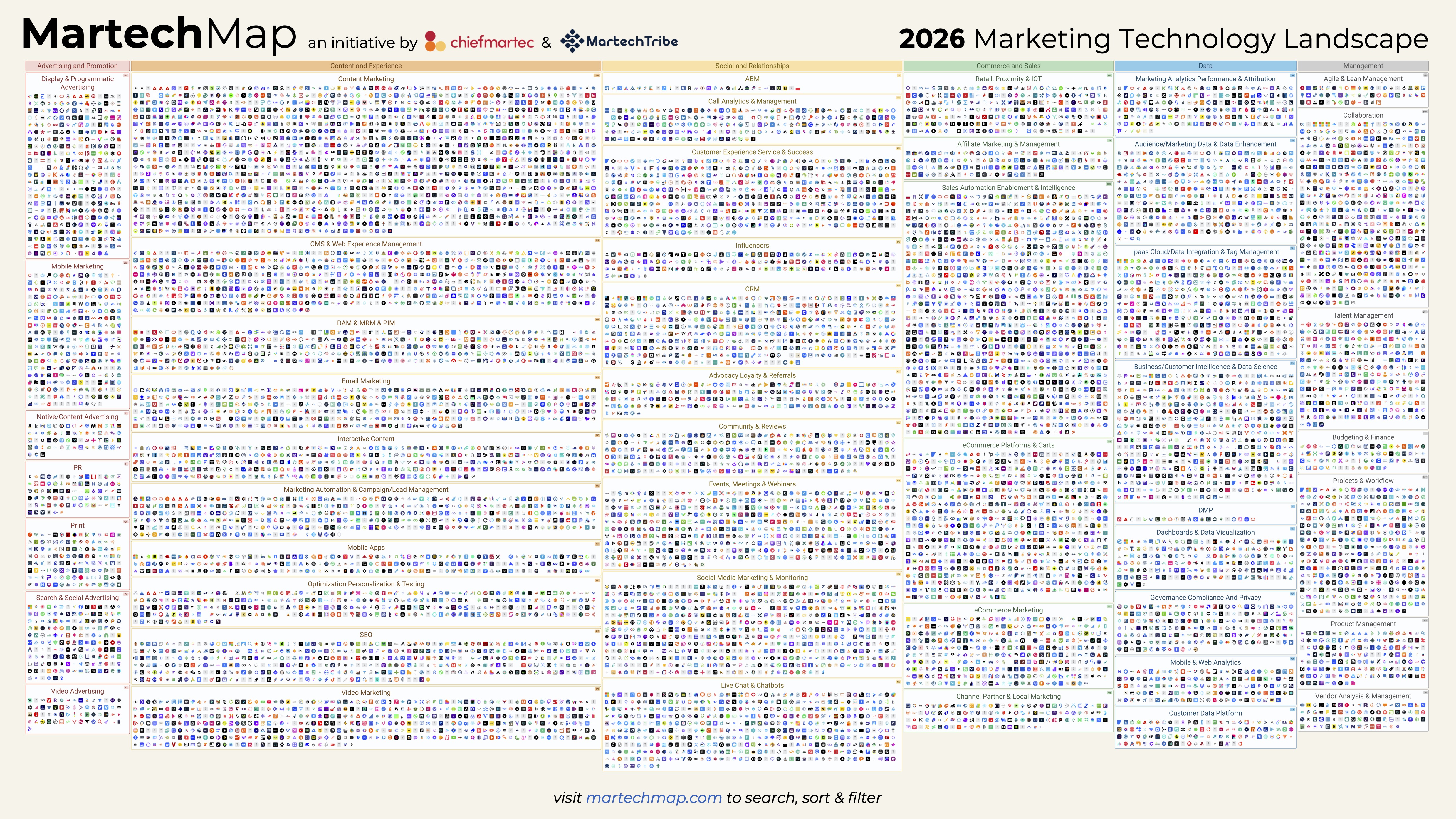
And most organisations are only using a fraction of what they've already bought. Gartner puts average utilisation of martech investment at 49%, and is dropping year on year.

It's taken me years to cut through the landscape here , and being honest the moment I feel I’ve caught up - more comes. It’s like whack-a-mole.
Analogies help to understand complex things. When I think about a system where everything happens automatically, and every part relies on every other part, there's no better one than the human body.
The brain 🧠
Helps you remember, organise and understand who your audience is
CRM: Your contact book. Keeps supporter info like names, preferences and history all in one place.
Data lake: The big messy cupboard. Holds raw data, in any format, before anyone's tidied it up.
Data lakehouse: The hybrid, stores raw data like a lake but adds enough structure on top to query it like a warehouse.
Data warehouse: The tidy filing cabinet. Holds data that's already been cleaned an organised into fixed tables, ready to query.
CDP: A customer data platform.Takes data from any of the above and organises it into useful audience groups based on how people behave or what they care about. Usually ready for activation in a campaign.
The nervous system ⚙️
Interprets stimulus and acts with the right message at the right time to the right person
Marketing automation: Detects behaviour and triggers timely decisions for when to act and what to send, based on what your audience is doing. Usually lives within your CXP.
Agentic AI: More on this soon. Your reflexes, responding intelligently without waiting for manual input.
Personalisation engines: Tailor content dynamically based on individual signals. Often part of other tools.
The muscles 💪
Where people see and experience your marketing in action.
CXP: A customer experience platform. Your control room sending out messages to different groups by email, SMS and more, at scale.
CMS: A content management system. Your website's backstage where you manage and update the pages your audience sees, engages and acts on.
Paid media tools: Uniting paid search, paid social and display advertising.
The senses 👃
Helps you track how people respond
Analytics tools: Your insight radar.Spots patterns in behaviour and tells you what's working and what needs improving.
Heatmaps and engagement reports: See what your audience is reacting to and where their attention goes.
A/B testing tools: Your test lab. Shows which message, image or idea performs better.
Tracking tools: Your listening tools. Watch clicks, opens and how people are talking about you and acting on it.
The mouth 👄
Where your marketing finds its words and its look
Content creation tools: Draft and adapt written content from subject lines to full campaigns.Can be AI powered or just where finished copy lives, ready to use.
Design and asset tools: Tools like Adobe, Canva or Figma. Create and adapt visuals from AI generated images to a stored library of approved photos, videos and design files and keep your visual identity consistent across every channel.
The skeleton 🦴
Holds everything together and lets every other system talk to each other
Integration platforms (iPaaS): Tools like Zapier or MuleSoft. Connect your CRM, media channels, CMS and everything else so data flows between them without manual exports.
APIs: The joints. Let one system request or send data to another in real time, rather than waiting for a manual export.
Middleware and ETL tools: Move and reshape data as it travels between systems so what leaves your CRM arrives in a format your CDP or warehouse can actually use.
Consent and governance tools: The rules that keep the whole skeleton safe to move. Manage what data you're allowed to collect, store and use and keep every other system compliant with it.
Why should charities invest in martech?
To put it in one line - our audiences are demanding it.
Gartner reports marketing budgets across all sectors average 7.7% of revenue. martech takes 2% of company revenue.
This is how the sector has become exposed. Underinvestment has left charity martech behind for years, and that gap is about to widen. Outside our sector experiences are radically different, they are predictive, dynamic and personal.
By 2028, AI is predicted to sit directly inside marketing technology workflows, making decisions from live data rather than waiting for a person to read a report and act on it. Uber and Netflix already run this way, successfully, today. Charities broadly do not. The organisations that get there first will pull away fast, and the gap will be much harder to close from a standing start.
Three things we need to do as a sector:
- We need to be more ambitious about the consistent experiences we design that meet the identified needs and expectations of our audiences.
- We need to commit to investing, and to sustaining that investment once the initial project ends.
- We need to be better equipped, with the methodologies and the people, to do this well.
AI and martech
Adoption of AI is no longer the question. Nearly every organisation, charities included, is using it in some form.
A 2026 benchmark study of 346 nonprofits found the gap clearly.
-
81% use AI individually, not in a workflow that’s shared
-
47% have no governance policy
-
4% have workflows
Virtuous & Fundraising.AI, The 2026 Nonprofit AI Adoption Report.
The commercial world is only slightly further ahead, and the shape of the gap is identical.
Gartner's 2026 CMO Spend Survey, covering 401 CMOs at mostly large enterprises, found only 30% of those CMOs consider their organisation actually ready to scale AI. 70% of them want to be seen as an AI leader this year. The same 70%, in the same survey, admit their internal processes aren't mature enough to get there.
What agentic AI actually means for your martech stack
"Right message, right person, right time" is the line every martech vendor pitches, and almost no charity fully delivers. The reason is simple. Doing it properly means making thousands of individual judgement calls, at a speed and scale no team can sustain by hand, so most organisations fall back on broad segments and best guesses instead.
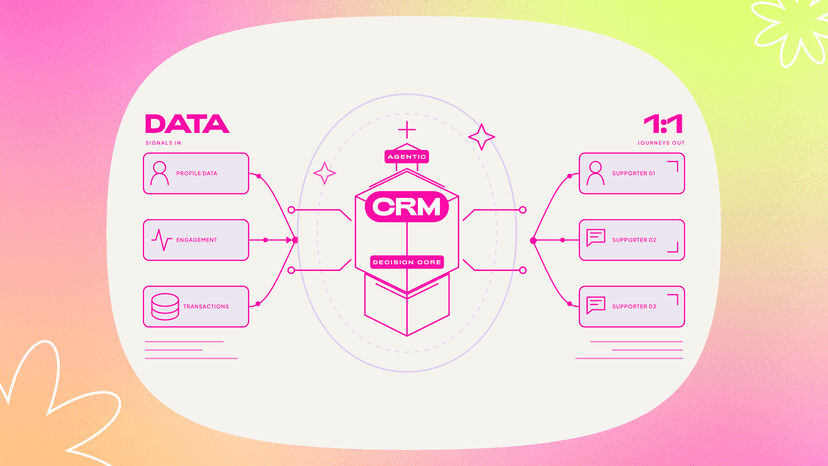
Agentic AI changes that. Feed it the data you've already collected, along with the rules, policies and processes you'd apply if you were making the call yourself, and it can hold that judgement at the level of one person, one moment, one decision, then act on it directly. Reads, decides, and executes (from pre-approved content, with lots of policies and governance).
The momentum behind this is real. Gartner's 2026 CIO survey found only 17% of organisations have deployed AI agents so far, but more than 60% expect to within two years. Gartner also expects more than 40% of agentic AI projects to be cancelled by the end of 2027, mainly over unclear ROI, rising cost and governance that never got built.
Both things are true at once. This is the real frontier, and most projects attempting it right now will fail to show a return.
This is important to start if you haven’t yet. Get the audit and the integration right first.
Responsible use also means being clear with your supporters about how their data is used, and giving your team the training and governance to use these tools with judgement rather than blind trust.
Why charity organisations struggle with martech
The same pattern shows up again and again.
The decision making. Marketing technology gets bought to solve one team's problem rather than the organisation's. Fundraising buys one thing. Campaigning buys another. Digital buys a third. None of them was in the room when the others made their decision, so multiple tools exist, usually doing the same thing.
-
The tools don't talk to each other, like a brain that isn't connected to its limbs and flailing around
-
Several expensive tools end up doing the same job
Teams end up working around their own tools and the gaps between other tools rather than through them. Spreadsheets fill the gaps the tools should be filling, and data gets copied and re-entered by hand until nobody fully trusts the numbers.
The audience feels this most. Supporters move across disconnected systems without knowing or caring that fundraising sits on a different budget to volunteering. They notice when an appeal doesn't recognise the time they've given. When a second donation welcomes them as if it were their first. When taking several different actions earns them a separate newsletter for each one.
None of this comes from bad technology or bad data. It comes from decisions that were, and weren’t made, about who owns the journey and what good looks like across teams.
Thoughts to finish
If I had just three things to leave with for what I’ve learnt you can’t under estimate:
- Fix the process, not only the tool. New tools need new business processes. New processes ask teams to plan, decide and hand work over in ways they haven't before. We've done a lot of this work with organisations, mapping and reshaping the process so the tool has something to plug into. Skip it and you pay more to run the same old fragmentation.
- Build the business case based on the opportunity. This technology directly impacts the audiences you reach. It should improve their experience, and it then should improve how they feel about you, and then what they go on to do with you. Anchor the decisions in what your audiences need, and what your teams need to deliver it. Show the value of the investment to lead to better outcomes. We built the Opportunity Calculator for this which is an online tool that requests data criteria about your organisation and iit uses industry benchmarks to estimate what the opportunity is worth.
- Don't underinvest in change. McKinsey found 70% of change efforts fail, and change management is the main reason. A new system rarely fails because the tech was wrong. It fails because it underestimates the need for people to think, work, and hand things over differently, and requires budgeting time or support for that change. You usually find the organisation is in thirds. One third - super up for it, can’t wait to get the new tech, one third is sceptical but will embrace if they feel supported, and one third is resistant to change and need support and communication. If you don’t invest in change, you lose two thirds and then, the old problems you tried to solve start to seep in.
So where do you start? That's the next article.
We walk through how to audit what you already have, turn audience and team needs into requirements, and build a stack and roadmap that deliver the change you want.
Your next read...
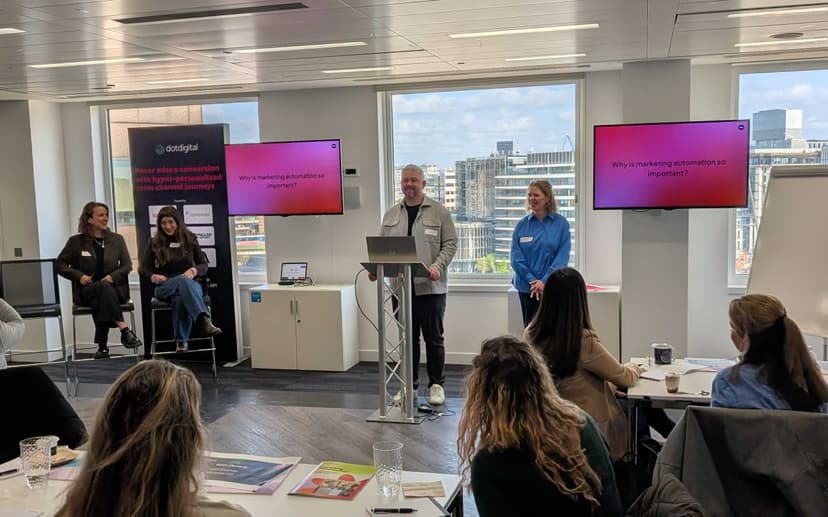
Building the case for tech and data investment
by manifesto28/04/2026Learn to build a winning case for tech and data investment with insights from industry experts.
Agentic customer journeys
by Lou Barton24/08/2026How agentic AI is changing supporter experience, and what the charity sector needs to do about it