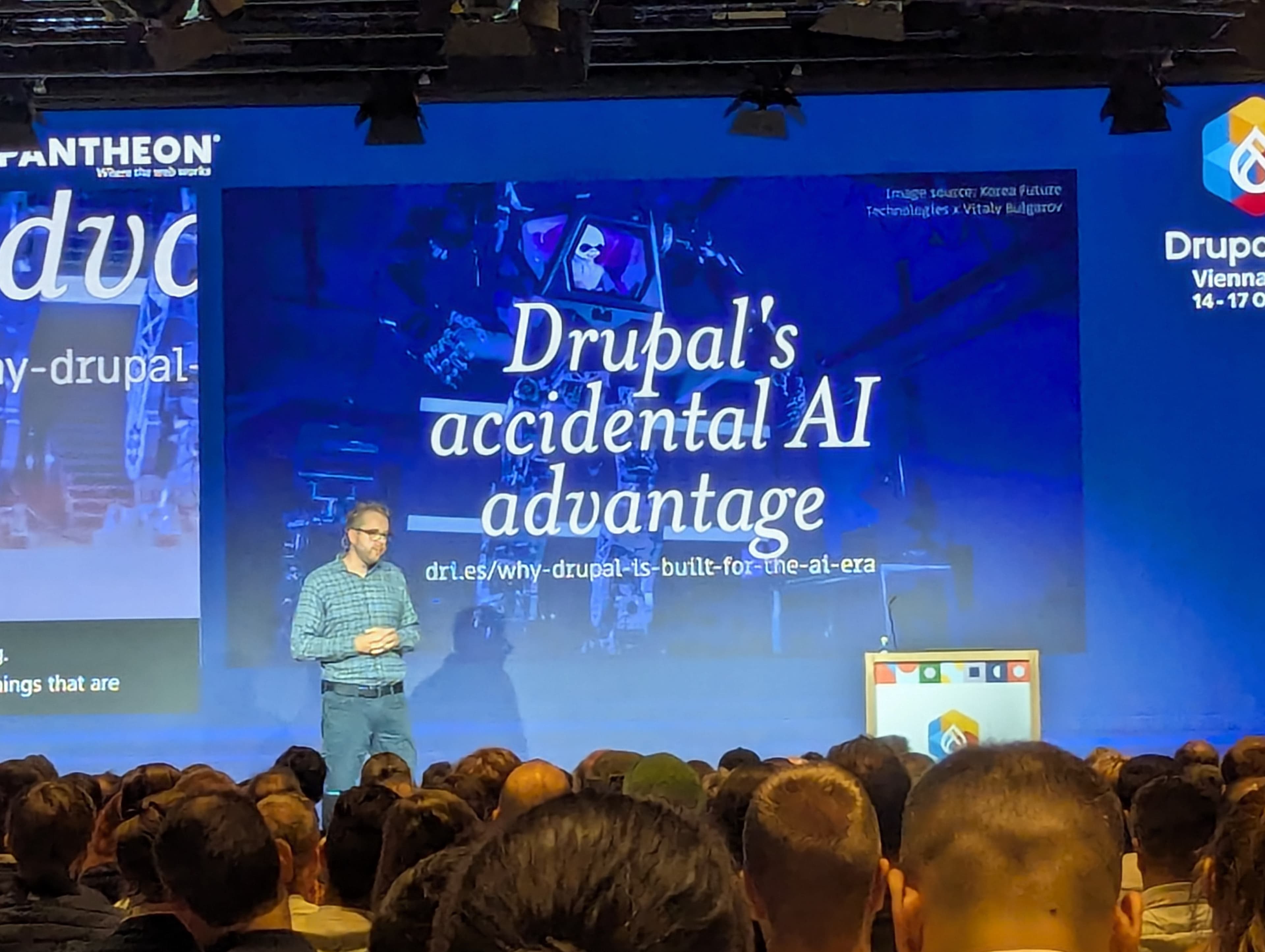

I’m just back from a fantastic and eye opening DrupalCon 2025 in Vienna, and my head is spinning (in a good way!) with the future of digital.
The undeniable theme of the conference was Artificial Intelligence. It’s not just a buzzword anymore; it’s fundamentally changing how we interact with the web. Dries Buytaert, Drupal’s founder, kicked things off with a stunning statistic: in May 2025, 69% of Google searches resulted in zero clicks because of AI powered overviews.
This changes everything for our clients in the charity, higher education, and cultural sectors. If users aren’t clicking through to your site, your website’s job has evolved. It’s no longer just a destination; it’s becoming a trusted, structured source of truth that feeds these AI models.
This new reality is driving a strategic shift in Drupal, and I saw two major themes that will help to define our technical approach for the next few years: Content Orchestration and Zero Code Content Management.
Drupal as your central content brain
For years, we’ve wrestled with a common challenge for our clients: you have a website, a CRM, a customer engagement platform, a ticketing system, a donation platform, and maybe a separate system for exam results or collection management. Getting them all to talk to each other is a massive, constant challenge.
This is where Content Orchestration comes in.
It’s about evolving your CMS from just a website publishing tool into the central content brain of your entire organisation. This new approach puts Drupal at the heart of an omni-channel content pipeline, allowing you to manage your content in one place and then orchestrate its delivery to any channel - whether that’s your website, a mobile app, an email campaign, or even an AI agent. In the past we have built custom orchestration tools to solve these API challenges for clients.
Now, this capability is coming to Drupal in a powerful new way with the Model Context Protocol (MCP). This is a new standard that officially lets Drupal act as the content context orchestration layer for external tools, especially AI.
We saw an amazing demo of this in action, where a news site used MCP to automatically:
-
Pull new articles written in Georgian from Drupal.
-
Send them to an AI to be summarised and translated into English.
-
Push the new English newsletter draft directly into MailChimp, all without a human lifting a finger.
That’s a perfect omni-channel pipeline: Create once in Drupal, publish everywhere automatically.
This is all powered by an amazing orchestration toolkit. For dynamic workflows inside Drupal, we can use ECA (Event - Condition - Action). This is a powerful no-code tool that lets us graphically build rules like “when this content is saved, validate it, notify this person, and assign this taxonomy term”. For connecting to the outside world, we can pair it with tools like ActivePieces (an open-source Zapier alternative). This hybrid approach lets us build incredibly sophisticated, reliable, and automated workflows that connect all your internal processes and external systems and audiences.
Empowering your team with zero code content management
The other side of this strategic coin is empowering your internal teams. Your marketing, fundraising, and content staff are the ones who know your audience best. They need to be able to create and launch new campaign pages, forms, and experiences fast, without having to wait in a developer’s ticket queue.
This is where Drupal Canvas (formerly Experience Builder) changes the game. It’s now in its Release Candidate and is set to become the default content experience in Drupal CMS 2.0 early next year.
Canvas is a modern, visual, component based page builder. But it’s not just about drag and drop; it’s about safe and structured creation. It already integrates with CKEditor and key modules like WebForm and MetaTag right into the Canvas interface.
What’s really exciting for our clients is the Mercury starter kit, which is built to work seamlessly with Canvas. It even has a specific Lumen site template designed just for non-profits. This means we can launch beautiful, highly-functional, and easy to manage sites for you more efficiently than ever.
And here’s where it all comes together:
-
We can use the new AI Context Control Center to define your organisation's brand voice, target audiences, and key facts.
-
Your marketing manager can then ask the AI to "create a landing page for our new webinar".
-
The AI will use your brand guidelines and the pre-built Canvas components to generate a complete, on-brand page in seconds, ready for you to review and publish.
This is a massive leap forward, giving your teams the speed and autonomy they’ve always wanted.
More than features: a smarter, sustainable strategy
Beyond these two big themes, a few other sessions really stood out for building a long term technical strategy.
Smarter governance
A brilliant talk on Yale University's Drupal implementation framed it as "subsidiarity at scale". This is a perfect model for universities or large non-profits: a central platform that provides power and tools, while allowing individual departments or schools to maintain their own autonomy and content structures.
Digital sustainability
We're finally getting Drupal-specific tools to measure our impact. We heard about a new carbon emissions module that can track your Drupal site's carbon footprint in real-time, right down to the page level. This is perfect for our mission driven clients who want to align their digital practice with their organisational values, and we will be keeping a close eye on its development with a view to incorporate it into our digital sustainability work in the future.
Why open source and digital sovereignty matter more than ever
A really interesting panel on the future of the web drove home a point that's critical for all of us, especially in the mission driven space.
In a world where AI is generating floods of content, and a few massive corporations are trying to control the web's standards (think how Gmail now dictates email rules, which weren't in the original standards), trust and authenticity are becoming your most valuable assets.
The panel predicted that "authentic, verifiable data" will become a premium commodity as the web fills with AI-generated "slop". This is where open source, and platforms like Drupal, become your strategic advantage.
Using open source isn't just a technical choice; it's a declaration of digital sovereignty. It means you truly own your platform, your content, and your data. You're not just "renting" space on a corporate controlled, closed source system. This allows you to be that "source of truth" Dries talked about, ensuring your brand and mission are represented authentically, independent of big tech's agenda.
What this means for you
My biggest takeaway is that Drupal is evolving from a Content Management System into a central, AI-ready Content Orchestration Platform.
The future of your digital strategy lies in:
-
Integrating your content across all your systems.
-
Empowering your non-technical teams to create freely.
-
Owning a sustainable, authentic platform you can trust.
It’s an incredibly exciting time to be in this space, and these new tools open up so many possibilities for the non-profit, cultural, and education sectors.
If you’re curious about how this new orchestration or zero-code approach could help your team, please get in touch. I’d love to chat!