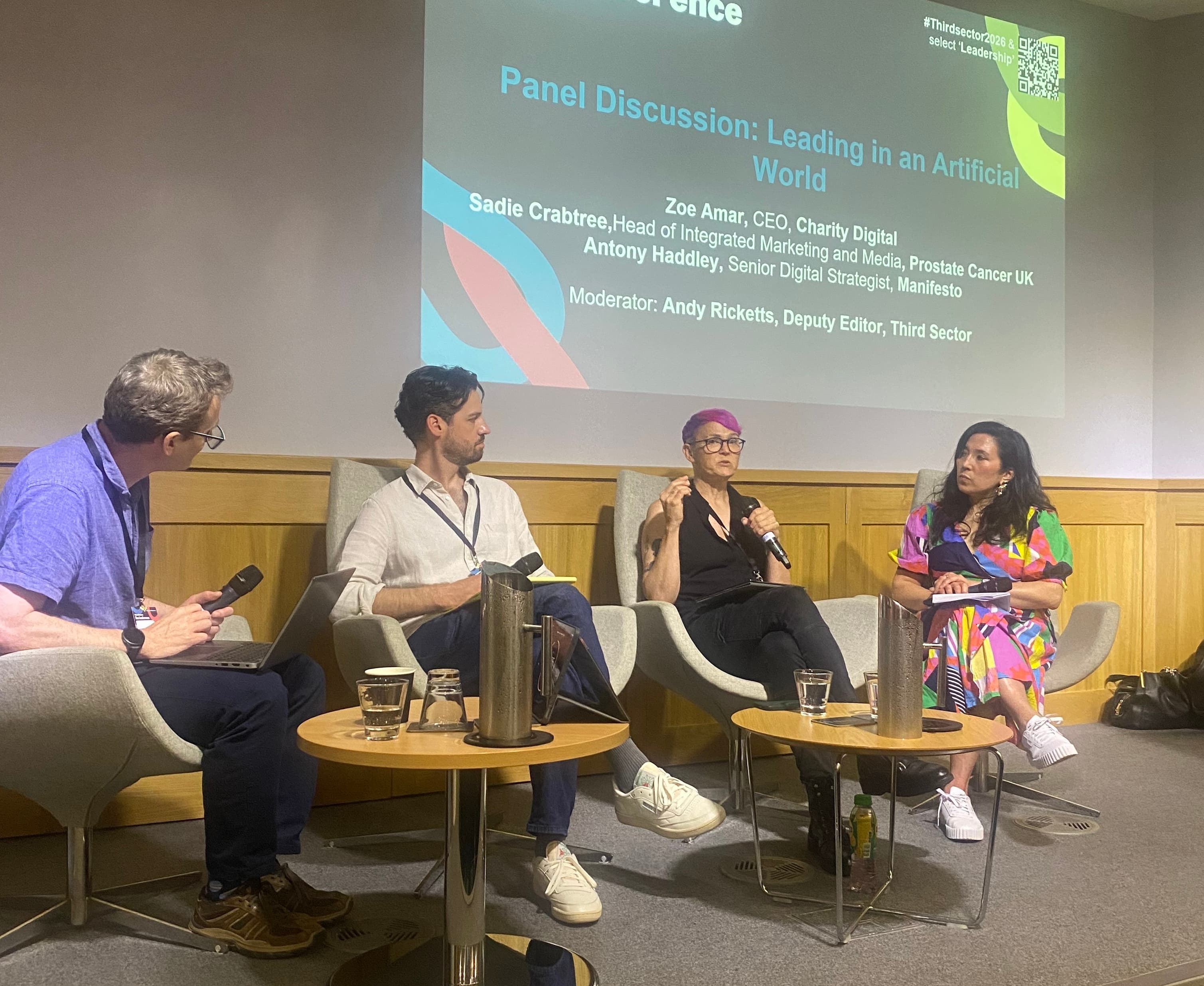

For those of you who work within the not-for-profit space, you will identify with the current thinking that the rapid rise of generative AI has presented leaders with a dichotomy. On one hand, there is seemingly limitless opportunity; on the other, a myriad of dilemmas.
At the recent Third Sector Conference, I got to see firsthand how non-profits are tackling these challenges head-on.
In a session titled Leading in an Artificial World, Zoe Amar (Trustee, Charity Digital), Sadie Crabtree (Head of Integrated Marketing and Media, Prostate Cancer UK), and Antony Haddley (Digital Transformation Strategist, Manifesto), the discussion focused on how leaders in the not-for-profit space can move past scattered experimentation to build truly confident organisations, with AI integrated seamlessly, starting from the very top.
Over a seriously thought-provoking 45 minutes, and in a packed-out hall, they covered a range of core themes and also gave us all some actionable takeaways.
Charity leaders have been doing a sterling job guiding teams through the early AI cycles, but the panel intimated clearly that now is the time to go deeper. They emphasised that navigating this shift requires balancing three particularly distinct mindsets:
-
Realism: Easy access to generative tools has not translated into easy implementation within everyday business processes. Currently, 1 in 5 organisations are not seeing a return on investment (ROI) on their AI projects yet. With many charities running on ever-tighter budgets and with higher expectations on outputs, they can’t afford to be experimenting with AI and making a loss. So the panel’s call for realism with what the tech can do right now really resonated with me.
-
Bravery: "Standing still is not an option". Antony compared the current transition to a travelator: "If you don’t get on board now, then it’s going to be difficult to catch up later." Getting on board involves tackling tough questions regarding data investment and determining whether AI can genuinely perform a task better than your staff. These questions can hit right at the heart of an organisation's identity and mission, and it’s probably the hardest mindset to crack.
-
Empathy: This integration will be a long, exciting, yet taxing journey of continuous learning and adaptation for teams. And whilst our sector is more than used to being agile with ever-changing landscapes keeping us on our toes, Sadie emphasised that leaders must act as visible role models during this transition to lead and support. At Manifesto, we are proudly human-centred, so I personally appreciated her very heartfelt emphasis on actively prioritising human connection and amplifying the human voice above just pure automation. People are at the heart of what we do after all, so leaders must maintain empathy for their staff and themselves, allowing everyone a safe space to share their concerns and ideas, and understanding that it is going to be hard,
A significant hurdle highlighted by the panel is how unreliable AI can be. For those in the healthcare space in particular, I am sure this will hardly be a surprise! While modern AI systems are remarkably capable, they remain inconsistent and can be highly unpredictable. This gives a level of risk that the third sector, especially with today's financial pressures, cannot easily absorb.
There were a few chuckles of recognition from the audience when Ant referred to the AI "Wizard of Oz " moment. This is the hallucination that occurs when the outputs are highly persuasive. They often push users to make decisions that seem superficially impressive or even just "sound right" rather than giving an accurate and factual output. Without proper guardrails, senior review time can get monopolised in correcting poor AI outputs, again, wasting time, resource and money. Imagine that AI generated email going out unchecked to hundreds of thousands of supporters….
While there’s understandable frustration with the recklessness of global AI companies, the panel noted a painful but liberating truth for charity leaders: we physically cannot control macro issues of global ethics and sustainability on a worldwide level. But we do need to know what we CAN control. So, instead of getting overwhelmed by global tech governance that’s out of our control, leaders should instead focus inward on safeguarding their own organisational ethics and deployment.
To mitigate against risks, the panel advised leaders must intentionally shift organisational culture away from rigid planning and delivery toward a more agile approach of constant learning, pivoting and building. They strongly recommended the following:
-
Rather than deploying top-down mandates, focus on cascading new standards by empowering teams to co-design your AI policies. Be a role model to enable the team to actively learn from each other.
-
Not everyone will be an ally immediately. Ant referenced our work with Blood Cancer UK, where we found that staff who were resistant to AI often had valid concerns around ethics, and had plenty of well-thought-through arguments and considerations. These weren’t just people resistant to change for the sake of it. Some of the best ideas and strategies happen when you get this dissonance, and the panel emphasised that this is all part of the process - all voices needed to be heard and appreciated. But of course, ultimately, the core message from the panel was that we need to realise that total AI resistance isn't a strategy - it's a viewpoint that leaves you behind. Is this a risk any of us is willing to take in the current climate?
-
A core insight for me was when Sadie highlighted the immense value of peer learning. This is something I value highly, working with my wonderful teams in Manifesto, and not just in AI. The panel urged against any temptation to innovate in isolation. Instead, they advised leaders to look closely at what similar organisations are doing, sharing both successes and failures with sector allies where possible to accelerate our collective progress.
-
The panel summarised neatly how AI can both help and hinder staff confidence. While it serves as an excellent tool to help shape correspondence, pitches or processes, it can also undermine staff expertise if they feel bypassed, overruled, or rushed by automated workflows.
Three actionable tips
-
When onboarding training providers, ask them to start with basic fluency concepts rather than jumping straight into advanced technical modules, which can be confusing and make your team lose confidence.
-
Be bold! Dedicate and protect time for experimentation and learning. Have fun. Don’t be afraid to “fail”. Use collective team learning to build that baseline organisational confidence, and the rest will follow.
-
Lean on structured, high-quality material such as Anthropic’s free AI fluency for nonprofits course. Ensure all staff, including leadership, complete it and discuss it collectively.
Conclusion
Successfully adopting AI is often seen as a key indicator of strategic success when you lead a digital organisation. This can feel overwhelming. But navigating this seismic shift doesn't have to be a solo effort. The main message I took from today was that balancing data preparation, ethical considerations, and team dynamics takes time, and - this part is key - collaboration. You learn best working collectively as a team, not in siloes, with the insights and strategy cascaded down from the very top, from the very beginning. Not an afterthought. In addition to the team learning, take time to gather any learnings from similar organisations in your sector to shape your approach and navigate this ever-changing and exciting landscape together.
Keen to benchmark on where your organisation is on its AI journey? Take our quick (<2 mins) self-check and discover exactly what to focus on next to build an impactful, scalable strategy.
Benchmark your organisation’s AI journey