Following the launch of The Hidden Cost report, I've been reflecting on the themes it raises and, more importantly, how to respond to them.
One of the biggest issues it surfaces is the understanding gap between leaders and "doers", and what that does to how digital work is quantified, defined, managed, prioritised and ultimately valued. When asked why this work stays hidden, 70% of respondents pointed to a lack of understanding of digital work at leadership level.
In our work at Manifesto, we see this across every sector: skilled digital teams fighting to be heard, decision-makers expecting results without grasping the effort behind them, and departmental leaders caught in the middle.
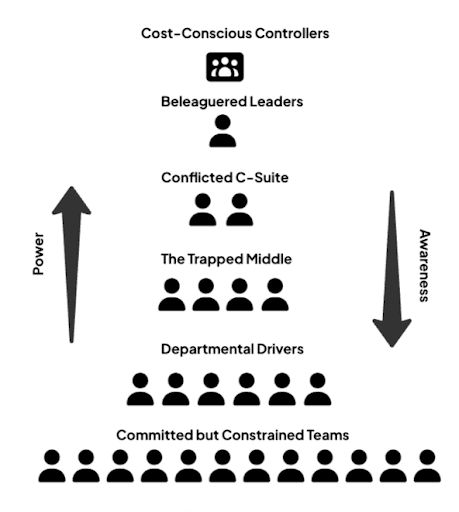
The digital disconnect
The paradox is clear: digital awareness and expertise sit at the bottom of the hierarchy, while the power to enact structural change sits at the top.
-
The top (Controllers & Leaders) often lack the literacy to see the invisible labour keeping systems afloat. They're less tapped into the processes that drive excellent digital experience
-
The middle (Trapped Middle & Drivers) are caught between executing legacy strategies and managing the burnout of their teams, while trying to enforce governance to assure quality.
-
The bottom (Committed Teams) hold the deep expertise and vision, but are constrained by rigid systems, a lack of institutional buy-in, and overwhelm.
The result is what the report exposes. Huge volumes of labour go unnoticed, roles aren't acknowledged or defined, and single points of failure create risk. The workforce is burning out: 62% had considered leaving in the past 12 months, rising to 71% among leads and heads of function. Real opportunity is left on the table too: broader audiences, better access, higher ticket sales and fewer complaints.
The new "thing" won’t fix systemic problems
In 15 years supporting organisations to use digital effectively, I've learned that a new digital product website, a sharper campaign or a better CRM, though important, rarely solve the underlying problems. Prioritisation, funding, governance, roles, culture and a clear vision are the real mechanics of a digitally capable organisation.
In Kotter's* terms, the report helps “create the right climate” for change. It evidences a need for urgency and gives us language to build a coalition around. What it can't do on its own is the harder part: removing the barriers, enabling action, and making the change stick. That takes people at every level doing something different:
For leaders
-
Learn what it actually takes. You don't need to do the work, but you do need to understand the effort, dependencies and risks behind it. Ask a team to walk you through a "simple" change from start to finish. It's often the fastest way to see the invisible.
-
Fund the running, not just the launching. Budgets that pay for new builds but not their upkeep create hidden labour by design. Maintenance, support and continuous improvement are operating costs, not optional extras.
-
Treat hidden work as organisational risk. Undocumented workarounds and knowledge held in one person's head are single points of failure. They belong on the risk register, not just in someone's inbox.
-
Bring digital into decisions early. Involve digital expertise when plans are made, not when they need delivering. Ensure that expertise is represented at decision making forums and at C-Suite/Board level
If you're in the middle
-
Make the invisible visible. Track unplanned work for a few weeks: the requests, fixes and workarounds that never appear on a plan. Then turn it into hours, cost and risk.
-
Translate. Present that evidence in the language leadership already uses, such as audiences, revenue, reputation and risk. Avoid framing it as workload.
-
Plan for reality. Build buffer capacity into plans for the work you know will come, and use evidence to say "not now".
-
Fix, don't just patch. Create a route for escalating root causes so recurring problems get solved rather than quietly absorbed.
-
Clarify ownership. Decide who owns what, and set up a clear route for "can you help with something digital?" requests, so they stop landing on whoever is nearest.
If you're doing the work
-
Name it. Keep a simple log of the unplanned work you do. This isn't a complaint. It's the evidence your manager needs to advocate for you.
-
Write down the workarounds. Documenting them reduces risk, makes your effort legible, and means you're not the only person who can keep things running.
-
Talk about outcomes, not tasks. "I spent six hours fixing the booking flow" lands differently from "the on-sale happened because the booking flow was fixed".
-
Remember it's the system, not you. Hidden work is a structural problem, not a personal failing. Look for peers across the sector who recognise it to
Where the layers meet
The real shift happens in the connections between layers. A few practical ways to build these into your organisation:
-
A shared definition of digital work that covers maintenance, support, data and the relational work of getting things agreed, not just shiny new projects.
-
Create a glossary of terms used to describe digital work, roles and practices that is shared across the organisation to avoid ‘lost in translation’ nuance and understanding
-
A quarterly digital review where teams show leaders what's been delivered and what it took, including the hidden work.
-
Governance that tracks capacity as seriously as it tracks delivery.
-
Job descriptions that reflect reality, updated as roles evolve rather than once every five years.
None of these require new technology. They require attention, honesty and a willingness to act on what you see.
This is a pivotal moment
The digital maturity gap is widening. AI is arriving as an amplifier of whatever conditions already exist, good or bad, and teams are at breaking point. Organisations that fix the foundations now will be the ones able to use AI well. Those that don't will simply automate their existing problems.
Start small. Pick one action from your section this week. The choice is no longer whether to see this work. It's whether, now that it's visible, we choose to act on it.
How Manifesto helps
We help organisations navigate this exact shift. We don't just build websites or design technical architecture. We help teams articulate their value and help leaders see the case for change, including through leadership sessions that build the understanding needed to create the right conditions.
Through targeted discoveries, digital maturity audits and collaborative strategy work, we map where you actually stand and set a vision for a digitally enabled future with measurable impact. We then turn that urgency into practical, prioritised roadmaps, so you can act now while staying ready for what's ahead.