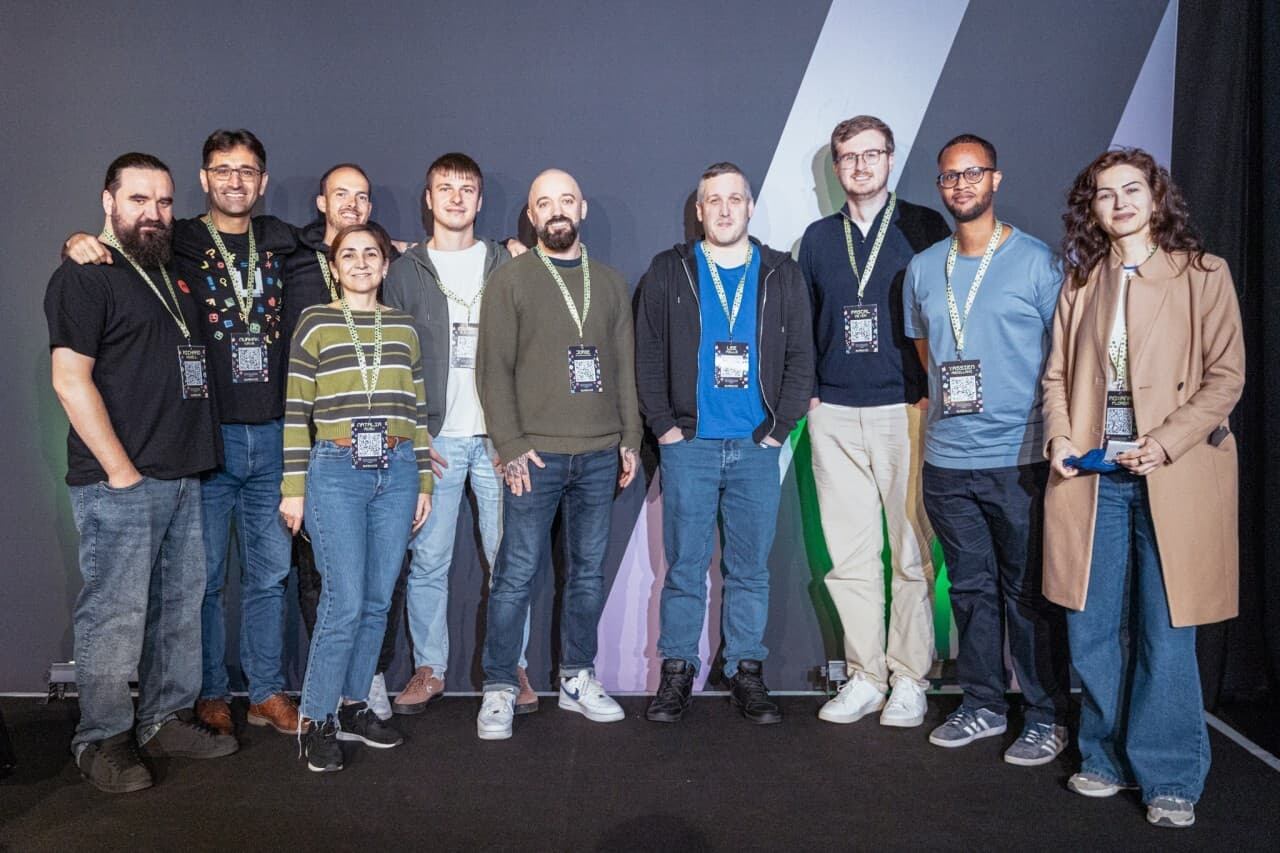

Ten of us from Manifesto, an Umbraco Contributing Platinum Partner, headed to CodeNode in London on 16 October for UMBUK26, the newly rebranded Umbraco UK Conference.
Run by the Umbraco UK Foundation, the day brought developers, creatives and partners together across three tracks of talks.This year's event felt more polished than any I've been to before, and the turnout was excellent. With three tracks running side by side, having ten of us there meant we could split up and cover far more ground than usual, then compare notes afterwards.
Partner Summit: MIB in three sprints
Before the main conference, our Solutions Architect and five-time Umbraco MVP Nurhak Kaya took to the stage at the Umbraco UK Partner Summit alongside our client, the Motor Insurers' Bureau (MIB). Nurhak co-presented with Sarah Cooper, MIB's Communications and Campaigns Manager. Ross Pollock, MIB's Creative Content Lead, helped shape the talk.
Their talk, "Delivering Umbraco Cloud v17 Site in 3 Sprints", told the story of how we moved MIB from a legacy Umbraco 6 site to Umbraco Cloud v17. The new site went live after just three two-week development sprints, three months from build planning to launch. Umbraco Cloud's ready-made environments, Cloudflare CDN, auto-scaling and built-in security meant the team could focus on features for MIB from day one.
A big part of that speed came from RazorKit, our open-source component preview tool for ASP.NET Core Razor. Inspired by Storybook, it lets developers, designers and content editors build and review components in isolation, without waiting for the CMS. That meant MIB's content team could get started on staging early, working in parallel with development.
The results speak for themselves:
- 73 pages built from scratch on flexible content blocks
- More than 40,000 words of new plain-English content, written for reading age and WCAG 2.2 accessibility
- More than 150 new images and videos, plus 10 real-life case studies
- No major issues found in penetration testing
- Zero downtime at launch
You can see the result at mib.org.uk. Thank you to Sarah and Ross for being such great partners, on stage and throughout the project.
Thursday: street food and darts
The conference really started the night before. While Umbraco partners were at the Partner Summit, the rest of us gathered for street food and drinks at Spitalfields Market. It was a great chance to catch up with familiar faces from the community before the main day.
From there we joined the Partner Summit crowd at Flight Club Shoreditch for the official pre-party, where the darts got very competitive, very quickly.
A fresh new look
The day kicked off with Mike Masey (Kent), Carole Rennie Logan (Scotland) and Owain Jones (Wales) introducing their developer communities and the work they've been doing. Callum then took the stage for the main introduction and revealed the new Umbraco Conference brand, which felt genuinely fresh. Alongside it came news that the event's style is changing to give it a clearer identity next to Umbraco Spark, the developer-focused conference in Bristol. I think that's a smart move.
Bolette Kern, Umbraco's Head of Product, then gave the keynote product update to set the scene for the day. A conference game app also ran throughout the event, adding some fun between sessions causing plenty of QR scanning over lunch. It was a good chance to meet new community members. I say fun, however, Matthew Hart, you will not be forgiven.
Talk highlights
Umbraco Automate, Rick Butterfield
Automate is the thing I'm most excited about from the whole day. It's a drag-and-drop automation engine built right into the back office, using the same permissions and data as the CMS, not a separate platform bolted on the side. Every run records each step's inputs, outputs and errors, so "why didn't that email go out?" can be answered in seconds. For developers, extending it is refreshingly simple: custom triggers, actions and connections are just a base class, with no registration step.
Beyond the Happy Path, Carole Rennie Logan
Carole made the case for non-functional requirements: performance, security, accessibility, observability and the rest. They're hard to demo because their value lies in what doesn't happen. That matters more than ever now, because AI-generated code works well on the happy path but skips your standards unless you tell it what they are.
CSI: Umbraco, Jason Elkin
Jason's forensic take on performance came with a line that stuck with me: there's no such thing as slow code, only too many instructions. He showed how Application Insights profiler traces can find the smoking gun quickly, before reaching for heavier tools like dotTrace and BenchmarkDotNet.
Ghosts of Umbraco Past, Joe Glombek
I have been working with Umbraco for long time and worried I would be on the hit list in this talk, but it turns out that I was already following modern standards without realising it. Joe walked through patterns that were fine once but now haunt long-lived sites. The big one for us: since Umbraco 15's lazy-loaded cache, traversing the tree with Descendants() is far more costly than it used to be, so searching is the better route.
The great Umbraco search shake-up, Busra Sengul
Search was a recurring theme, and Busra compared Examine, Algolia and Azure search options side by side, which was useful context as Umbraco's own search story evolves.
Beyond shift left, Mike Masey
Mike's accessibility talk was one of the most thought-provoking of the day. His key question for every meeting was: "Who does this leave out?" He showed how one hour with a blind developer improved his AI-built contrast tool more than weeks of tweaking. He also reminded us that accessibility isn't one team's job, because brand, product and finance decisions shape it long before a developer gets involved.
From tribal knowledge to AI teammate, Marcin Zajkowski
Marcin's advice was refreshingly practical. Start capturing your tribal knowledge from pull requests, colleagues and the questions juniors ask. If an instruction file is enough, don't over-engineer your AI setup. And remember that AI catalyses what's already in your team, good and bad.
The branding journey
Branding isn't usually my thing, but I went along to the branding session anyway and I'm glad I did. Hearing about the journey they went, first finding themselves falling into the classic IT blue cliche, followed by nearly finding their logo spelling something in appropriate and finally ending with the new brand was really insightful. The end results spoke for themselves.
Closing the day
The closing keynote, "What Umbraco HQ Hasn't Thought Of (Yet)", came from Umbraco's developer relations team, Lotte Pitcher and Sebastiaan Janssen. It was funny and well paced. Seeing what the community is building is always my favourite part, and it was an excellent way to end the day.
Afterwards we headed to The Globe in Moorgate for the after-party. It was a great wind-down, with lots of conversations about the talks we'd each seen.
What the team took away
The talks at UMBUK this year gave a really clear picture of where Umbraco is heading, especially with AI tools, search, and cleaner workflows. It was great to come away with practical ideas we can actually use in our daily work right away
Jorge de los Santos Rodriguez, Senior Developer
A great community day, packed with smart, thought-provoking sessions. It's a community that genuinely shares what it knows, and everyone benefits.
Pascal Meyer, Lead Developer
It was great to experience the conference together as a team. There’s something about hearing the same talks and bouncing ideas around afterwards that you just don’t get on your own. For me, the standout was Umbraco Automate. We’re already thinking about how we can use it to add real value to our clients’ websites.
Lee Mills, Principal Developer
A big thank you to the Umbraco UK Foundation, the speakers, sponsors and volunteers for a brilliant couple of days. We're already looking forward to next year.
A special thank you to Clive Cooper and Callum for helping us get our team photo. Organising ten developers into one shot is a lot like herding kittens, I should have created a Jira ticket. We really appreciate their patience