
Challenge
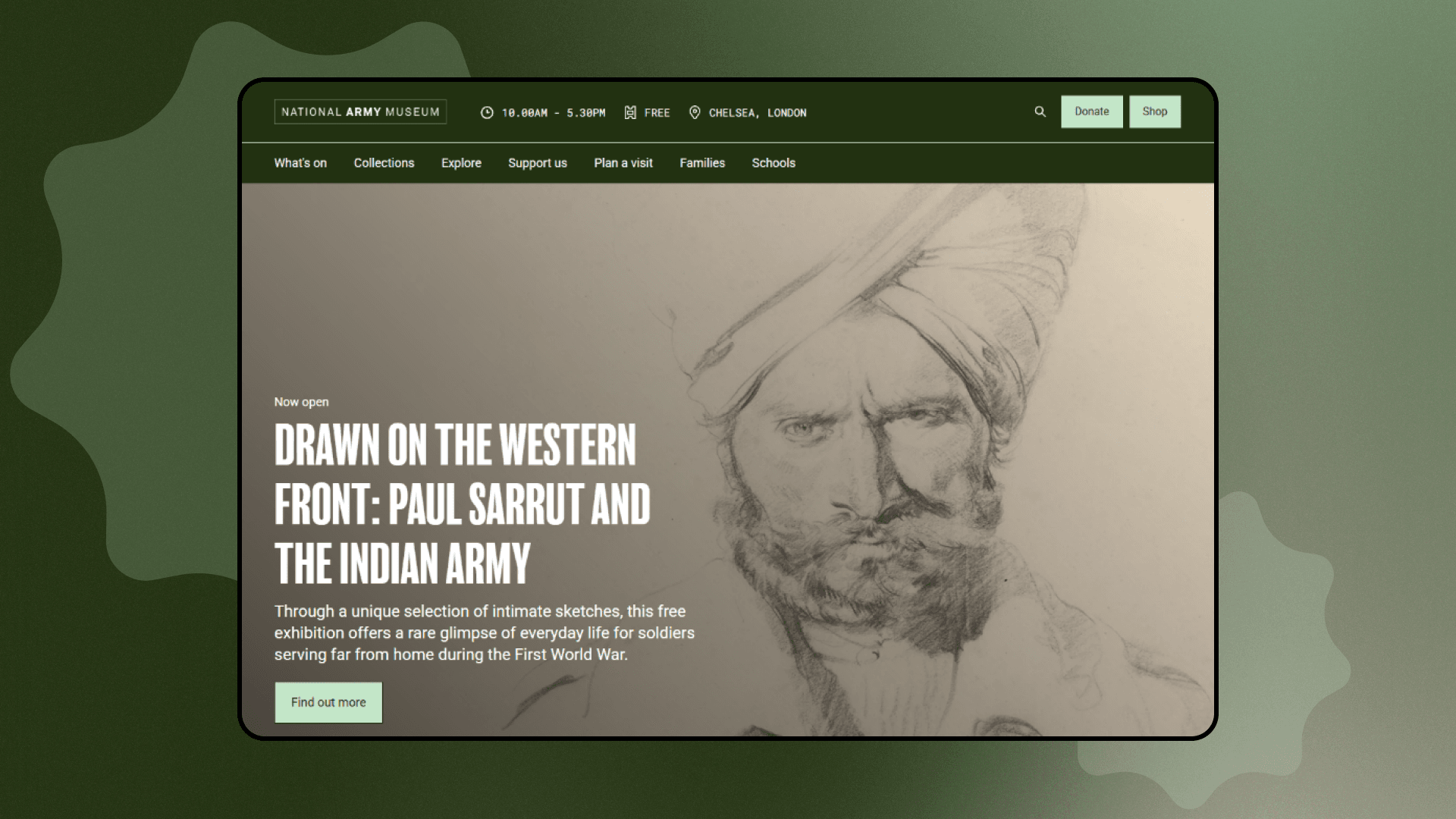
The National Army Museum (NAM) had recently unveiled a refreshed brand identity - bold, confident, and visually striking. The challenge? Their existing website was eight years old, built on outdated front-end infrastructure with legacy components and minimal flexibility. A full-scale rebuild wasn’t feasible within their constraints. NAM needed a cost-effective, efficient way to apply their new visual identity without disrupting core functionality or content structure.
They partnered with us to make this happen. Our task was to update the site’s front-end design, translating a print-focused brand into an accessible and coherent digital experience. Working within tight limitations, no structural redesigns, minimal component changes, and editor-driven layouts - we had to be precise in our approach. The goal: a refreshed, accessible digital presence that retained brand integrity and worked seamlessly across existing templates.
Solution
We took a component-led approach, identifying high-impact elements such as hero banners, calls to action, cards, and navigation menus. These components appeared across multiple pages, making them ideal touchpoints for scaled brand consistency without requiring wholesale redesigns.
The project began with a workshop involving NAM stakeholders and the brand agency. This early alignment allowed us to understand the rationale behind the refreshed brand and collaboratively explore how it could translate to the digital space. Our design exploration included reviewing existing and proposed components live, which encouraged feedback and shaped a shared visual direction early in the process.
In terms of delivery, our process focused on visual adaptation, not reinvention. We reskinned components where possible, carefully introducing new branded blocks without disrupting the CMS or site structure. This allowed us to enhance the visual appeal while maintaining editorial control and technical stability.
The brand’s typography, originally designed for print, was adapted for web accessibility, employing increased letter spacing and sentence case in long-form content. Colours were tested rigorously to meet WCAG 2.2 AA standards, resulting in a digital-first palette that balanced vibrancy with inclusivity.
A key success factor was the structured feedback loop: each design phase concluded with focused review sessions to maintain alignment and ensure sign-off efficiency, especially given the tight timeline.
Impact
The refreshed NAM website successfully embodied the new brand identity within the constraints of a legacy system - without reworking content, navigation, or back-end functionality. We delivered a lightweight, accessible, and visually coherent design system that seamlessly fit within existing structures.
Our work resulted in a library of scalable, branded components tailored to real-world editorial use. The internal teams retained their flexibility and content control while gaining a more modern, visually unified platform.
By opting for a strategic Frontend Rebuild rather than a cosmetic Reskin, the National Army Museum achieved a high-performance digital presence that is compliant with 2026 accessibility standards. This decision successfully bypassed the 'Legacy Trap,' delivering a 10%-20% improvement in development efficiency and deferring a full-scale £150k+ system replacement by an estimated five years.
Most importantly, the project demonstrated that with thoughtful adaptation, a strong brand can live vibrantly in digital - even without a ground-up rebuild. The process has empowered NAM to continue evolving their site confidently, with a foundation that’s technically sound, accessible, and on-brand.
Applying a new visual identity to an established website with years of existing content and component development was a challenge we hadn’t tackled before. Manifesto’s clear methodology, practical guidance and ongoing support gave us the confidence to deliver the transition smoothly, with far less complexity than we had originally anticipated.
Kevin Blaney, Website Development OfficerNational Army Museum