
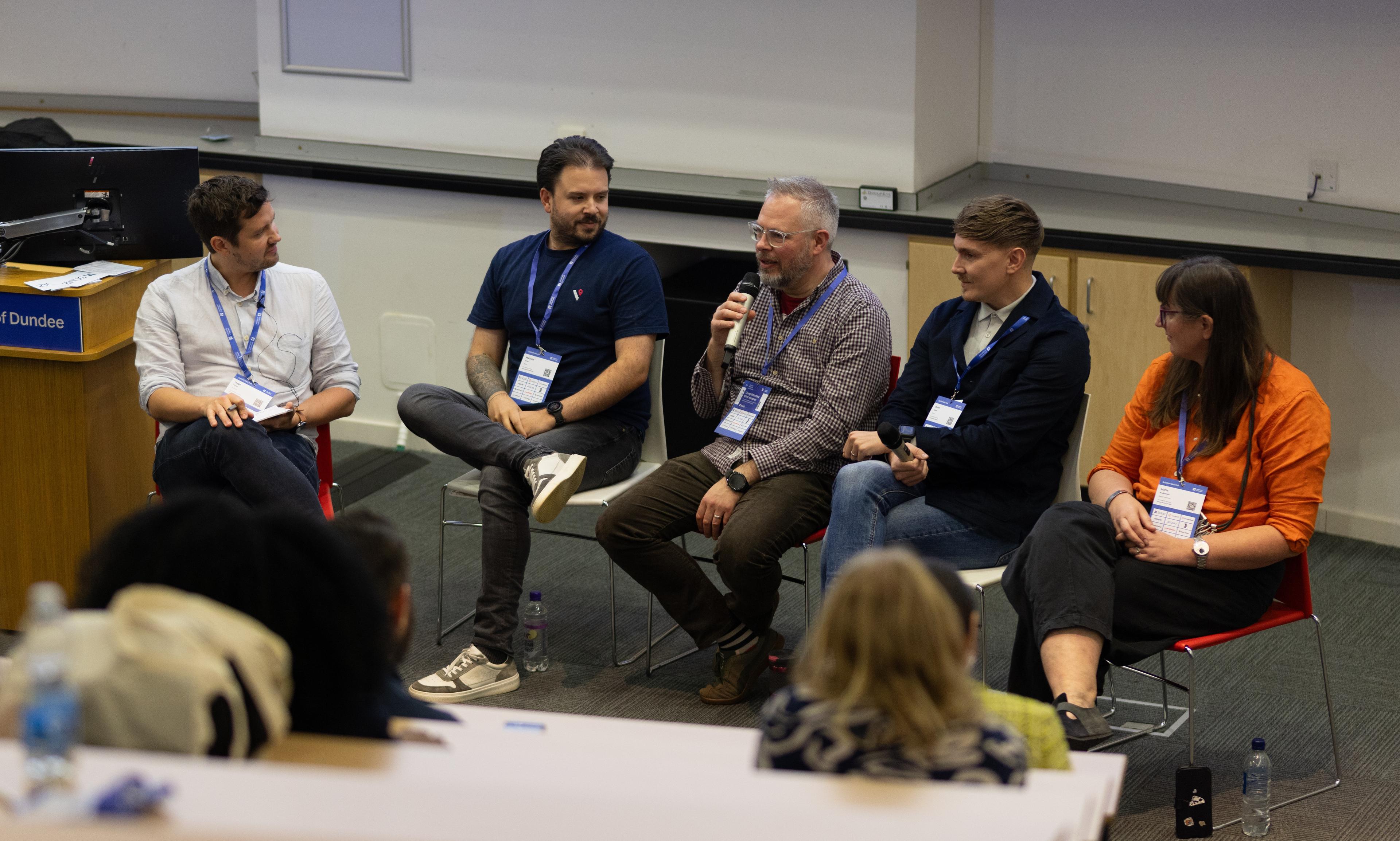

We’ve just returned from Scottish Web Folk, an event Manifesto is proud to have sponsored for the fourth consecutive year. One of the defining features of this annual gathering is how the theme leans directly into the sector's most pressing realities. Last year, the focus was squarely on doing more with less, set against the grim backdrop of an industry battered by financial woes. This year, it was inevitable that the conversation would be dominated by the defining tension of the moment: Humans vs. AI.
As moderator of this year’s higher education digital panel, my objective was simple: cut through the theoretical hype and understand how university digital teams and technology partners are actually wrestling with artificial intelligence right now.
While conversational AI dominates the headlines, the real challenges facing institutions are structural, operational, and cultural. Over 45 dense minutes, our panellists unpacked exactly where AI accelerates real-world output, where it falls completely flat, and why human judgement is rapidly becoming a university's most critical differentiator.
The shifting front door: Search, visibility, and discoverability
For decades, the prospective student journey followed a well-worn funnel: newspaper league tables, university prospectuses, search engine queries, and open days. Today, that entry point looks fundamentally different.
Citing a recent UCAS report covering 4,000 respondents, panellist Stuart Davies, Account Executive at Acquia highlighted a reality digital teams can no longer ignore: 48% of students now use AI to begin their university discovery process. Instead of sifting through pages of search results and institutional websites, prospective applicants are entering highly personalised, multi-layered prompts to get instant synthesis.
But are universities ready for this? When Stuart’s team benchmarked 113 institutions across 40 questions during the high-stakes clearing window, the findings were sobering: institutions with vague, unstructured content simply failed to surface. Cambridge and Bangor appeared prominently in certain queries, while other institutions were entirely absent on critical topics like accommodation because their web content wasn't structured for large language models to parse.
As Matt Jones, Head of Product and Engineering at Vepple pointed out, AI discoverability doesn't eliminate the university website, it changes its role from an initial search target to a vital verification point. Students use AI for broad strokes, but they don't place blind trust in it; they actively seek a "second source of truth". If an institution's underlying data, course facts, and campus facilities aren't machine-readable and citeable, the student will never reach the primary site to begin with.
In-house workflows: Code acceleration vs. content failures
Moving from prospective students to internal operations, the panel revealed a stark divide between technical development and content creation.
On the development front, AI is an undeniable multiplier. Neil Allison, Head of Prospective Student Web at the University of Edinburgh, described how his team rapidly deployed new clearing features for admissions staff. A technical lead at Edinburgh likened using AI to managing two or three extra contractors, generating iterations and functional code in seconds rather than days.
Attempting to apply generative AI to institutional voice and content design, however, proved to be an entirely different story. Neil candidly shared that content designers spending time exploring how AI could write or edit content with them was an "abject failure". The technology failed to respect style guides, write in a voice that reflected the brand, or even speak in simple English for students.
Bangor University took a smarter, problem-led approach. Facing the perennial sector problem of academics providing jargon-led descriptions, Marta Krukowska, Web and Digital Manager, deployed an AI agent not to write copy, but to act as an internal interviewer. When an academic claims a department has "state-of-the-art facilities," the agent pushes back, flagging the generic answer and asking what it actually means for a student. By acting as a neutral buffer, the agent extracts authentic, concrete detail without creating friction between the digital team and academic staff.
The Welsh dimension: Bilingual parity and the trap of automated translation
Operating within Wales presents unique digital challenges. Maintaining full parity between English and Welsh content means managing double the digital real estate with a team size comparable to an English or Scottish institution.
Marta issued a strong caution against the rush toward automated AI translations, noting that while algorithms handle text functionally, they strip out nuance, warmth, and authenticity. Visitors might read heartfelt, engaging copy in English, only to switch to the Welsh section and find the best job a robot could do - providing a detrimental experience for those choosing to explore content in Welsh.
Compounding the issue, student research behaviours don't follow neat language assumptions. Welsh-speaking students often begin their queries on English pages, meaning institutions must explicitly detail Welsh language provisions and cultural context across the entire digital estate, rather than compartmentalising them into siloed Welsh sub-pages.
Radical transparency and retention
We tackled how institutions handle difficult truths, specifically around realistic living costs and the local availability of part-time work.
Bangor and Edinburgh agreed that hiding harsh realities in promotional material is a failing strategy in an AI-driven search ecosystem. If a university is vague about the cost of living in an expensive capital city or a limited rural job market, students immediately turn to unvarnished sources like Reddit, The Student Room, and AI syntheses of community forums. Large language models pull from these candid discussions, meaning sugar-coated marketing is directly contradicted before an application is even lodged.
Institutions build foundational trust by providing transparent cost-of-study data, realistic regional employment guidance, and clear course timetabling. Radical honesty at the front door prevents the misaligned expectations that directly damage student retention later on.
Where human judgement is non-negotiable
Closing the session, I asked each panellist where human judgement must remain untouchable.
Matt emphasised that while build cycles and execution will become faster and more automated, discovery, product-market fit, and defining what to build will always require human intuition.
Neil reinforced this by referencing Gerry McGovern’s classic UX principle: you cannot design digital experiences by assembling people in a room to drink lattes and guess what users want. No model can replace direct observation of real students navigating actual tasks. There is, after all, a "U" in UX.
Stuart concluded with an apt metaphor: technology offers a massive collection of instruments, but an orchestra without a human conductor is simply uncoordinated noise.
AI will undoubtedly continue to transform the mechanics of search, software delivery, and data processing. But understanding user motivation, preserving institutional trust, and delivering genuine empathy remain deeply, stubbornly human.
As we pack up from another brilliant event, we’re already looking forward to seeing how these conversations evolve at the 5th birthday of Scottish Web Folk next year.